
The structural integrity and safety of barrier netting systems, such as those used in sports facilities, construction sites, and agricultural applications, are critically dependent on an accurate assessment of wind-induced forces.

This guide examines the essential principles and methodologies for calculating wind load on barrier nets. It outlines a systematic process that begins with the physical characteristics of the netting, specifically the solidity ratio, which quantifies the proportion of solid material to open space. The analysis then incorporates aerodynamic principles, focusing on the determination of the appropriate drag coefficient as a function of the net’s porosity.

Furthermore, the guide emphasizes the critical role of meteorological data and engineering standards, such as ASCE 7, in establishing a design wind speed that accounts for geographical location, topographical features, and gust effects. By integrating these variables—net solidity, drag coefficient, and design wind pressure—a comprehensive formula for calculating the total wind force is presented.

This objective framework empowers procurement managers and project engineers to develop precise technical specifications, mitigate risks of failure, and ensure the long-term durability and safety of their netting installations.
Principales conclusiones
- Determine the net’s solidity ratio, as it is the foundation for all subsequent force calculations.
- Use local building codes and standards like ASCE 7 to find the accurate design wind speed for your site.
- Apply the correct drag coefficient, which changes based on the netting’s porosity and shape.
- Properly calculating wind load on barrier nets is a critical step for ensuring project safety and longevity.
- Translate your final calculations into precise specifications when communicating with your netting supplier.
- Partner with manufacturers who provide testing data to verify their products meet calculated load requirements.
- Consider how environmental factors like ice or debris can alter the net’s solidity and increase forces.
Understanding the Stakes: Why Wind Load Calculation is Non-Negotiable
Imagine for a moment a towering golf driving range barrier net, stretching hundreds of feet into the air, standing guard at the edge of a property. To a casual observer, it is a simple screen. To an engineer, a project manager, or a facility owner, it is a massive sail. The invisible force of the wind, when applied across this vast surface, generates immense loads that can bend steel poles, snap cables, and lead to catastrophic failure.

The process of calculating wind load on barrier nets is therefore not a mere academic exercise; it is a fundamental pillar of public safety, financial responsibility, and project viability.
An error in this calculation, or worse, its omission, introduces a cascade of risks that can have profound consequences.
The Hidden Dangers of Underestimation: Safety and Liability
The primary concern in any structural design is, and must always be, human safety. A barrier net that fails under a predictable wind event becomes a significant hazard. Support poles can collapse, and the netting material itself, along with its hardware, can become dangerous projectiles. For a construction site, this could mean endangering workers and the public. For a sports facility, it could mean risks to athletes and spectators. The legal and ethical responsibilities are immense. In the aftermath of a failure, forensic analysis will inevitably examine the design and specification process.

A documented, standards-based approach to calculating wind load serves as a critical element of due diligence, demonstrating that foreseeable risks were identified and properly mitigated. Without it, a project owner or contractor may face severe liability claims, reputational damage, and regulatory penalties.
The Financial Domino Effect of Netting Failure
Beyond the immediate safety risks, the financial implications of a netting failure are substantial. The initial cost of the netting and its installation represents only a fraction of the total potential loss. A collapse necessitates not only replacement of the damaged materials but also de-installation of the failed system, potential damage to surrounding property, and the complete cost of a new installation. More disruptive, however, are the secondary business interruption costs. A golf course may need to close its driving range for weeks, losing significant revenue during a peak season.

A construction project can face costly delays, incurring penalties and disrupting timelines for other trades. These indirect costs often far exceed the direct cost of the netting itself, turning what seemed like a cost-saving shortcut into a major financial liability.
Beyond the Obvious: Wind’s Impact on Netting Lifespan and Performance
Even if a net does not fail catastrophically, a system that is inadequately designed for its wind environment will suffer from accelerated wear and tear. Constant, excessive movement and vibration from wind-induced flutter can cause premature material fatigue in the netting fibers, a phenomenon known as mechanical degradation.
This is particularly relevant for materials like HDPE and nylon, which, while durable, have finite fatigue lives (Mori, 2021). Hardware components, such as clips, shackles, and cables, will experience repeated stress cycles, leading to loosening or failure. The result is a system that requires more frequent maintenance, constant re-tensioning, and ultimately, a much shorter operational lifespan than one designed with a proper understanding of its environmental loads.
An accurate wind load calculation allows for the specification of a system that performs not just on the windiest day, but for thousands of days, ensuring a better return on investment.
Step 1: Deconstructing the Net – Solidity Ratio and Material Properties
Before we can understand how the wind acts upon a net, we must first understand the net itself. Unlike a solid wall, a barrier net is a porous structure. Its interaction with the wind is defined by its physical makeup: the material of its twines, the size of its openings, and the thickness of the fibers. The single most important parameter in this analysis is the solidity ratio. It is the key that unlocks the entire calculation, translating the abstract concept of a “net” into a quantifiable engineering variable.
What is Solidity Ratio (φ) and How to Determine It?
The solidity ratio, often represented by the Greek letter phi (φ), is a simple yet powerful concept. It is the ratio of the solid, projected area of the net’s twines to the total area of the net. Imagine looking at a one-square-foot section of netting.

The solidity ratio is the percentage of that square foot that is blocked by the twine, while the remainder is open space, or porosity.
A net with a high solidity ratio will block more wind and thus experience a greater force, behaving more like a solid surface.

Conversely, a net with a low solidity ratio allows more wind to pass through, resulting in a lower force.
Calculating the solidity ratio requires two basic measurements: the twine diameter (d) and the mesh size (M), which is the dimension of one side of a square mesh opening. The formula is:
φ = (2d/M) – (d/M)²
This formula accounts for the area of both the vertical and horizontal twines, subtracting the small overlapping area at the knots. For a procurement manager, this means that you cannot specify a net based on mesh size alone. A 2-inch mesh made with a 3mm twine will have a completely different solidity ratio and wind load characteristic than a 2-inch mesh made with a 5mm twine.
| Twine Diameter (d) | Mesh Size (M) | Solidity Ratio (φ) | Wind Interaction |
|---|---|---|---|
| 2.0 mm | 50 mm (approx. 2″) | 0.078 | Low force, high wind passage |
| 3.0 mm | 50 mm (approx. 2″) | 0.116 | Moderate force, good balance |
| 4.0 mm | 50 mm (approx. 2″) | 0.154 | Higher force, more blockage |
| 3.0 mm | 25 mm (approx. 1″) | 0.226 | Substantial force, significant blockage |
As the table illustrates, small changes in twine diameter or mesh size can have a significant impact on the solidity ratio, and consequently, the wind load.
The Role of Material Choice: HDPE vs. Nylon vs. Polyester
The material from which the net is made influences its strength, durability, and response to environmental factors. While the material does not directly enter the primary wind load formula, it is a critical selection criterion that ensures the net can withstand the calculated forces over time.
- High-Density Polyethylene (HDPE): This is the most common material for outdoor barrier netting, especially for applications like golf course netting. HDPE is hydrophobic, meaning it does not absorb water, so its weight and properties remain stable in rain. It possesses excellent UV resistance, which is vital for longevity in sunny climates. Its lightweight nature also reduces the dead load on the support structure.
- Nylon (poliamida): Nylon boasts a higher tensile strength and abrasion resistance than HDPE, making it suitable for high-impact applications like baseball backstops. However, it is hydrophilic—it can absorb water, which makes it heavier and causes it to sag. While this can be mitigated with coatings, it is a factor to consider.
- Poliéster (PET): Polyester offers a balance of properties. It has high strength, low elongation (stretch), and better UV resistance than nylon. It is also hydrophobic, like HDPE. It is often used in applications requiring high strength and dimensional stability, such as cargo and safety nets.
Your choice of material should be a deliberate one, based not just on the calculated wind load but also on the specific environmental challenges of your location—be it intense sun, heavy rain, or the need for exceptional impact strength.
Mesh Size and Twine Diameter: A Delicate Balance
The interplay between mesh size and twine diameter is a balancing act. For a sports barrier, the mesh must be small enough to stop the intended projectile—a golf ball, a baseball, a hockey puck. This sets a maximum allowable mesh size. Once that is established, the twine diameter must be selected. A thicker twine offers greater breaking strength and durability but, as shown in the table above, it also increases the solidity ratio and therefore the wind load. This increased load may then require a more robust and expensive support structure (poles, cables, and foundations).

The process of calculating wind load on barrier nets forces a holistic view of the project, where a simple choice about the netting itself has direct consequences for the entire structural system. It is an optimization problem where safety, performance, and cost must all be considered in concert.
Step 2: Understanding the Wind – Velocity, Pressure, and Local Factors
Once we have quantified the physical nature of the net, our focus shifts to the force acting upon it: the wind. Wind is not a simple, constant pressure. It is a dynamic, chaotic fluid, and its behavior is influenced by a host of factors, from large-scale weather patterns to the small hill just upwind of your site.
To properly calculate wind load, we must move from a general idea of “a windy day” to a specific, defensible number called the “design wind speed.”

From Wind Speed to Dynamic Pressure (q): The Basic Formula
The kinetic energy of moving air is what exerts a force on a structure. This force is captured in the concept of dynamic pressure, or wind pressure (q). The relationship between wind speed and wind pressure is not linear; it is exponential. This is a vital point to grasp: doubling the wind speed does not double the pressure; it quadruples it. The formula that governs this is:
q = 0.5 * ρ * V²
Let’s break this down:
- q is the dynamic pressure, typically measured in Pascals (Pa) or pounds per square foot (psf).
- ρ (rho) is the density of air. While it varies slightly with temperature and altitude, a standard value of 1.225 kg/m³ (or 0.002377 slugs/ft³) is commonly used for calculations at sea level.
- V is the velocity of the wind. This is the most critical and variable component of the equation.
The challenge, then, is not in the formula itself, but in determining the correct value for V, the design wind speed.
Finding Your Design Wind Speed: Using ASCE 7 and Local Codes
You don’t have to guess the wind speed. For decades, engineers and meteorologists have been collecting data and refining models to predict wind events. This work is codified in building standards that provide the basis for structural design. The most widely used standard in North America is the ASCE 7, “Minimum Design Loads and Associated Criteria for Buildings and Other Structures.” The latest version is ASCE 7-22.
These standards provide wind speed maps that divide the country into zones based on historical weather data. For example, coastal regions in Florida and the Gulf Coast are in high-velocity hurricane zones, with design wind speeds far exceeding those in a calmer inland region like Kansas. A procurement manager in Canada would consult the National Building Code of Canada (NBCC), which serves a similar purpose.

These maps provide a basic wind speed. This speed is then adjusted by a series of factors to arrive at the specific design wind speed for your project’s exact location and height. It is not sufficient to simply Google “average wind speed” for your city. You must use the code-specified basic wind speed for your risk category, which reflects the consequences of failure (an empty field has a lower risk category than a public stadium).
Gust Effects and Topographical Factors: Why Averages Aren’t Enough
Wind is rarely a steady stream. It comes in turbulent gusts. A 70 mph wind is not a constant pressure; it is a series of impacts and lulls. Engineering codes account for this using a gust-effect factor (G), which amplifies the calculated load to account for the dynamic response of the structure to these rapid changes in wind speed.
Furthermore, the ground-level environment dramatically alters how the wind behaves. The ASCE 7 standard defines several “Exposure Categories” to account for this. Think about how wind feels in an open field versus in the middle of a dense city. The buildings in the city break up the wind flow.
| Exposure Category | Site Description | Wind Effect |
|---|---|---|
| B | Urban and suburban areas, wooded areas, or other terrain with numerous closely spaced obstructions. | Obstructions slow the wind near the ground. Lowest wind loads. |
| C | Open terrain with scattered obstructions, including flat open country and grasslands. | The “default” category for most projects. Moderate wind loads. |
| D | Flat, unobstructed areas exposed to wind flowing over open water for at least one mile. | No obstructions to slow the wind. Highest wind loads. |
A site’s location on a hill or escarpment also matters. A structure placed on the crest of a hill will experience accelerated wind speeds, and codes provide a topographical factor (Kzt) to account for this.

Ignoring these factors—gusts, exposure, and topography—can lead to a dangerous underestimation of the true forces your barrier net will face. The process of calculating wind load on barrier nets demands this level of detail to be truly effective.
Step 3: The Physics of Force – Applying the Drag Coefficient (Cd)
We have now defined the net’s physical form (solidity) and the wind’s power (dynamic pressure). The next step is to connect them. How does a specific amount of wind pressure translate into a specific force on a particular net? This is where the concept of the drag coefficient comes into play. It acts as a multiplier that characterizes how efficiently an object catches the wind. It is a dimensionless number that encapsulates all the complex aerodynamic effects—like turbulence and flow separation—into a single, usable value.

Defining the Drag Coefficient for Porous Structures
For a simple, solid, flat plate held perpendicular to the wind, the drag coefficient (Cd) is approximately 1.2. This means the force on the plate is 1.2 times the dynamic pressure multiplied by the area. However, a net is not a solid plate. Air flows through it as well as around it. Consequently, the drag coefficient for a net is always less than that of a solid object of the same size.
Determining the precise drag coefficient for netting has been the subject of extensive research, including wind tunnel testing and computational fluid dynamics (CFD) simulations. These studies, such as those summarized by the Engineering Sciences Data Unit (ESDU 80025, 1980), have shown that the drag coefficient is overwhelmingly a function of the solidity ratio (φ).
How Solidity Ratio Directly Influences the Drag Coefficient
The relationship is intuitive: as the solidity ratio increases, the net becomes more “solid,” blocking more air and thus having a higher drag coefficient. As the solidity ratio approaches zero (an empty frame), the drag coefficient also approaches zero. As the solidity ratio approaches 1 (a solid panel), the drag coefficient approaches that of a solid plate.

While complex formulas exist, several empirical models provide excellent approximations for practical use. For example, one common model shows that for a solidity ratio of 0.1 (a fairly open net), the drag coefficient might be around 0.9. For a solidity ratio of 0.3 (a denser net), the drag coefficient could increase to around 1.1. It is crucial to understand that this relationship is not linear.
The character of the flow changes with solidity. At very low solidities, the wind passing through the openings has little interaction with the flow passing around the edges. As solidity increases, these flows begin to interact, and the pressure on the downstream side of the net changes, altering the overall force.

This is why you cannot simply multiply the solid area by a fixed coefficient; you must use a drag coefficient that corresponds to the overall solidity of the entire net.
Experimental Data vs. Theoretical Models: A Practical Approach
For a procurement manager, the key is to ensure your supplier is not using a guessed or assumed drag coefficient. A reputable manufacturer should be able to provide data or reference established engineering models that justify the drag coefficient used in their calculations for a given net construction. They should be able to explain why a net with a 25mm mesh and 3mm twine has a specific drag coefficient, and how that differs from a net with a 50mm mesh.

This is where the value of experience and technical expertise becomes apparent. A supplier who has conducted their own testing or relies on established engineering data (such as that from organizations like the Civil Engineering Research Foundation) can provide a much higher degree of confidence. They are moving beyond a generic formula and applying data-driven insights specific to the products they manufacture.
When you are assessing suppliers, ask them about their methodology for determining the drag coefficient. Their answer will reveal a great deal about their technical competence.
Step 4: Putting It All Together – The Core Wind Load Formula
With the net’s solidity ratio defined, the wind’s dynamic pressure calculated, and the appropriate drag coefficient selected, we can now assemble these components into the final equation to determine the total force on the netting. This is the culmination of our analysis, providing the critical number that will inform the design of the entire support structure—from the poles and foundations to the cables and connection hardware.
The Fundamental Equation: Fw = q * A * Cf
The total wind force (Fw) on the netting is calculated using a straightforward formula that integrates the variables we have discussed:
Fw = q * A * Cf
Let’s examine each term:
- Fw is the total Wind Force, the final result we are seeking. It is typically expressed in Newtons (N) or pounds-force (lbf). This is the load that the poles and anchors must be designed to resist.
- q is the design Wind Pressure we calculated in Step 2, which already accounts for the location’s basic wind speed, height, exposure category, and gust effects.
- A is the total projected Area of the net (Height × Width).
- Cf is the Force Coefficient. This is directly related to the drag coefficient (Cd) we discussed in Step 3. For a freestanding screen or net perpendicular to the wind, the force coefficient is often taken to be equal to the drag coefficient derived from the solidity ratio.
This formula provides the total force acting on the face of the netting.

It is this force that must be transferred through the attachment points, down the poles, and into the ground.
A Step-by-Step Worked Example: Calculating Wind Load for a Golf Barrier Net
Let’s make this tangible. Consider a hypothetical project for Robert, the procurement manager in Canada. He needs to specify a barrier net for a new driving range near Halifax, Nova Scotia.

- Project Details:
- Netting Height: 15 meters
- Netting Width: 50 meters
- Proposed Netting: HDPE, 25mm mesh, 3.0mm twine
- Location: Open, flat terrain near the coast (Exposure D)
Step A: Calculate Net Properties
- Area (A) = 15 m × 50 m = 750 m²
- Solidity Ratio (φ): Using the formula (2d/M) – (d/M)², with d=3mm and M=25mm. φ = (2 * 3 / 25) – (3 / 25)² = 0.24 – 0.0144 = 0.2256
Step B: Determine Design Wind Pressure (q)
- Robert consults the National Building Code of Canada (NBCC) and finds the hourly wind pressure for Halifax is, for this example, 0.8 kPa (800 Pa). This value already includes factors for a high probability of being exceeded annually.
- The NBCC provides adjustment factors. For Exposure D at 15m height, the exposure factor (Ce) might be 1.2. A gust effect factor (Cg) of 2.0 is typical for flexible structures.
- Design Pressure (q) = (Reference Pressure) × Ce × Cg = 800 Pa × 1.2 × 2.0 = 1920 Pa (or 1.92 kPa).
Step C: Determine Force Coefficient (Cf)
- Based on the solidity ratio of ~0.23, Robert’s supplier consults engineering data (like ESDU 80025) and determines an appropriate force coefficient (Cf) is approximately 1.0.
Step D: Calculate Total Wind Force (Fw)
- Fw = q × A × Cf
- Fw = 1920 N/m² × 750 m² × 1.0 = 1,440,000 N
- To convert to a more intuitive number, this is 1,440 KiloNewtons (kN) or approximately 323,700 pounds-force.
This is a massive force. It is the equivalent of stacking more than 30 cars on the face of the net. This number demonstrates unequivocally why a casual approach is unacceptable.
This calculated force is what the structural engineer will use to design the diameter of the steel poles, the depth of the concrete foundations, and the required breaking strength of the support cables.
Accounting for Shielding and Angled Wind
The real world adds complexity. If multiple rows of nets are used, the upwind net “shields” the downwind nets, reducing the force on them. Codes provide methodologies to account for this shielding effect, which depends on the solidity of the nets and the distance between them.
Additionally, wind rarely strikes perfectly perpendicular to the net. When wind hits at an angle, the force is reduced.

However, for a conservative and safe design, it is common practice to calculate the load based on a perpendicular wind direction, as this represents the worst-case scenario for the primary support structure.
Step 5: Beyond the Calculation – Selecting a Supplier and Ensuring Compliance
The process of calculating wind load on barrier nets is an essential analytical step, but it is only half the battle. The most accurate calculation is worthless if it cannot be translated into a real-world product that performs as specified.
The final, and arguably most critical, step is to use this information to select a competent manufacturing partner and ensure the final product aligns with your design intent.

This is where the procurement manager’s due diligence bridges the gap between theory and a safe, durable installation.
From Theory to Reality: Translating Calculations into Specifications
Armed with the knowledge from the previous steps, you can now write a highly effective and precise Request for Quotation (RFQ). Instead of vaguely asking for “heavy-duty golf netting,” you can specify:
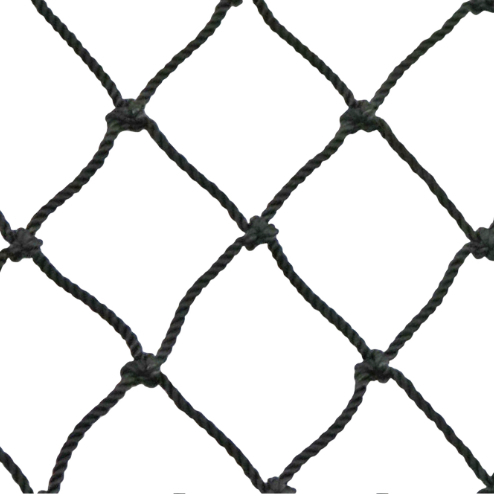
Golf Hitting Nets
- Mesh Type: Diamond
- Mesh Size: 3/4″
- Material: Black DuPont™ Type 66-728 Knotted Nylon
- Breaking Strength: 125 lbs.
- Thickness: 1.32mm
- Twine: #15
- Water Repellent: Yes
- Border: 3/8″ nylon rope
Sold by the square foot
“We require 750 square meters of a durable sports netting system with the following characteristics: HDPE material, 25mm square mesh, 3.0mm twine diameter. The netting system, including all hardware, must be certified to withstand a calculated peak wind load of 1,440 kN, based on the site’s design wind pressure of 1.92 kPa as per NBCC guidelines. Please provide documentation supporting the force coefficient used in your product’s rating.”

This level of specificity accomplishes several things. It immediately filters out suppliers who lack the technical expertise to understand, let alone meet, the requirements. It shifts the conversation from one based solely on price to one based on performance and safety. It also creates a clear, contractual basis for performance, protecting you from under-engineered products.

The Importance of Third-Party Testing and Certification (SGS, TUV)
How can you be sure that a supplier’s product actually meets the specified strength? This is where independent, third-party verification becomes invaluable. Certifications from internationally recognized testing bodies like SGS or TUV provide objective proof of a product’s capabilities.

A trustworthy supplier should be able to provide test reports for their products. These reports don’t just cover the net’s breaking strength; they can also include data on things like:
- Tensile Strength Testing: Verifying the force required to break the twine and the mesh knots.
- Weather Resistance Testing: Using accelerated weathering chambers (UV exposure, temperature cycles, moisture) to simulate years of outdoor use and confirm the material’s durability.
- Dimensional Stability: Confirming that the mesh size and shape hold true under load.

When a manufacturer states their netting can handle a certain load, ask for the test data that backs it up. This commitment to quality control is a hallmark of a reliable partner and directly addresses the pain point of receiving products that fail to meet performance requirements.
Why a One-Stop Solution Matters: From Calculation to Installation Support
The wind load on the net is only one part of a complete system. That load must be managed by the cables, poles, and anchors. A major challenge in large netting projects is coordinating between the netting supplier, the cable provider, and the structural engineer. A disconnect between these parties can lead to critical errors.

This is why a supplier offering a “one-stop solution” provides such a significant advantage.
A vertically integrated partner who can not only manufacture the custom netting but also assist with the initial wind load assessment, specify the correctly-rated hardware, and provide detailed installation guidelines eliminates many potential points of failure.
They ensure that the entire system is designed holistically, with each component rated to handle the forces calculated for the netting itself. This approach reduces coordination costs, minimizes the risk of incompatible components, and provides a single point of responsibility for the performance of the entire barrier system. It directly addresses the common frustrations of project delays and communication breakdowns that arise from juggling multiple vendors.

Preguntas más frecuentes (FAQ)
How does the height of the netting installation affect wind load?
Height has a significant effect. Wind speed generally increases with altitude due to reduced friction from the ground and surrounding objects. Engineering codes like ASCE 7 provide height and exposure factors that increase the design wind pressure as the installation height goes up. A net installed at 20 meters will experience a substantially higher wind load than the exact same net installed at 10 meters at the same location.
Can I use a standard wind load calculation for all locations?
No, this is highly dangerous. Wind loads are fundamentally site-specific. A net that is perfectly safe in a low-wind inland area could fail catastrophically in a coastal hurricane zone or on a mountain ridge. Using local building codes (like ASCE 7 in the US or the NBCC in Canada) to determine the basic design wind speed for your precise geographical location is a mandatory first step for a safe design.
What is the difference between static and dynamic wind load?
Static load refers to a constant, unmoving force, like the weight of the net itself (dead load). Wind, however, is a dynamic load because it is not constant; it fluctuates rapidly with gusts and turbulence. The total wind load calculation includes a gust-effect factor to account for this dynamic nature, which can amplify the forces on a flexible structure like a net.
How does ice or snow accumulation impact wind load on nets?
Ice or snow accumulation can dramatically increase wind load. It does so in two ways: first, it adds significant weight (dead load) to the netting. Second, and more critically for wind load, it can fill the mesh openings, drastically increasing the net’s solidity ratio. A net that is 20% solid when dry could become 80% or even 100% solid when coated in ice, effectively turning it into a solid sail. This will increase the wind force exponentially. In climates where icing is possible, this potential must be factored into the design.
Does the color of the netting affect its durability against wind and UV?
The color itself does not directly affect the wind load calculation. However, it can influence long-term durability. The carbon black used to create black HDPE netting is an excellent UV inhibitor, which is why black is the most common and often most durable color for outdoor netting. Other colors use different UV inhibitor packages that may offer slightly less protection over many years. Therefore, for maximum lifespan in sunny environments, black is often the recommended choice.
Why is a factory-direct supplier often better for custom netting projects?
A factory-direct supplier offers several advantages. They have direct control over the manufacturing process, allowing for precise customization of material, mesh size, and twine diameter to meet your specific calculated load requirements. They possess deep product knowledge and can provide technical support, test data, and certifications. This eliminates communication errors and markups from middlemen, often resulting in a higher-quality, more reliable, and cost-effective solution that directly addresses your project’s engineering needs.
The endeavor of calculating wind load on barrier nets is far more than an exercise in applied physics; it is a foundational act of responsible project management. It represents a commitment to safety, a strategy for financial prudence, and a mark of professional diligence. By moving beyond simplistic assumptions and engaging with the core variables—solidity ratio, design wind speed, and drag coefficients—a buyer is empowered. You transform from a passive recipient of quotes into an informed architect of your own project’s success.
This methodical approach demystifies the invisible forces of nature, translating them into actionable data. This data, in turn, allows for the creation of precise specifications that form the basis of a strong supplier relationship. It enables you to ask the right questions, demand verifiable proof of performance, and select a manufacturing partner who understands that a netting system is an integrated structure, not just a roll of material.
Ultimately, a properly calculated wind load ensures that your barrier net will not only serve its primary function of stopping a ball or securing a site but will also stand resiliently against the most powerful, unseen force it will ever face: the wind.
Lea nuestros artículos más populares.
👉 Descargue gratuitamente nuestras categorías de productos
👉 The Ultimate Guide to Installing Anti-Insect Nets in Greenhouses
👉 The Ultimate Guide to Choosing the Right Cargo Netting for Your Fleet
👉 HDPE vs Nylon Sports Netting: The Ultimate Guide
👉 A 5-Step Expert Guide: “Made to Order”: A Look at Our Custom Netting Process
👉 Cómo Empezar un Negocio de Redes de Marca Propia: Un marco de trabajo en 5 pasos
👉 La fabricación china frente a los proveedores locales: Guía del comprador de redes