
Selecting between HDPE and Nylon Sports Netting is not an easy task; choosing an appropriate material for sports netting is a significant decision for facility managers, procurement officers, and club administrators, with direct implications for safety, performance, and long-term financial implications.

This analysis provides a comprehensive examination of the two predominant materials used in the industry: High-Density Polyethylene (HDPE) and Nylon. The discourse centers on a comparative evaluation of their intrinsic properties, including tensile strength, resistance to environmental factors like ultraviolet radiation and moisture, abrasion durability, and overall weight. It considers how these characteristics translate into performance within specific sporting contexts, such as high-impact applications like golf and baseball versus large-area containment for soccer and lacrosse.

The paper argues that a nuanced understanding of the trade-offs between HDPE’s superior environmental stability and Nylon’s exceptional strength is necessary for an optimal choice. The investigation concludes that the decision is not a simple matter of one material being universally superior, but rather a context-dependent calculation of needs, environmental conditions, and budgetary frameworks.
Rapid Reading:
- Nylon offers superior tensile strength, making it ideal for high-impact sports applications.
- HDPE provides excellent UV and moisture resistance, ensuring longer life in outdoor settings.
- Evaluate the lifetime cost, not just the initial price, for a better return on investment.
- The choice in the HDPE vs. Nylon: Choosing the Best Material for Sports Netting debate depends on your specific sport and climate.
- Nylon absorbs water and can sag, requiring consideration for outdoor, humid environments.
- HDPE is lighter and does not absorb water, simplifying installation and maintenance.
Understanding the Contenders: A Material Science Primer
Before we can meaningfully compare High-Density Polyethylene (HDPE) and Nylon, it is helpful to step back and appreciate what these materials are on a fundamental level. Thinking about them not just as threads in a net, but as distinct chemical structures, illuminates why they behave so differently. This perspective allows us to move from simple observations—”Nylon is strong”—to a richer understanding of the principles that govern their performance.

Imagine you are building a wall. You could use bricks meticulously mortared together, or you could use interlocking stones of a specific shape. Both can create a strong wall, but their resilience to different forces—a direct impact, a constant pressure, or the slow erosion of weather—will vary based on their composition and the way they are joined. So it is with polymers like HDPE and Nylon.
What is Nylon?
Nylon is a family of synthetic polymers known as polyamides. Think of its molecular structure as a long, repeating chain of molecules linked by strong amide bonds. These bonds are cousins to the peptide bonds that link amino acids to form proteins in our own bodies. This chemical architecture is the source of Nylon’s famed strength and elasticity. The molecules are arranged in a way that allows them to align and stretch under tension, distributing force very effectively across the polymer chains before breaking.
This inherent strength, often referred to as high tensile strength, is Nylon’s signature characteristic in the world of sports netting (Allsport Netting, 2024). It can absorb a tremendous amount of energy, which is why it’s the material of choice for things that need to withstand sudden, powerful forces, from parachutes to climbing ropes, and, of course, high-impact sports nets.
What is High-Density Polyethylene (HDPE)?
HDPE, on the other hand, belongs to the polyethylene family of plastics. Its name, “High-Density,” gives us a clue to its structure. The polymer chains are long and have very little branching, allowing them to pack closely together in an orderly, crystalline fashion. This dense packing is what gives HDPE its rigidity and strength-to-density ratio.
Unlike Nylon, HDPE is a hydrocarbon polymer—it’s made of just carbon and hydrogen atoms. This simple, non-polar structure makes it inherently hydrophobic, meaning it repels water. It does not have the same types of bonds that make Nylon so susceptible to moisture absorption. Furthermore, its chemical stability makes it highly resistant to many solvents, acids, and, crucially for our purposes, the degrading effects of long-term sun exposure. It is a material built for endurance against the elements.
A Head-to-Head Comparison: Key Performance Metrics
To facilitate a clear and practical comparison, it is useful to distill the complex properties of these materials into a side-by-side format. The following table provides a summary of the most critical attributes a procurement manager or facility owner must consider when evaluating HDPE versus Nylon for sports netting.
| Característica | Nylon Netting | High-Density Polyethylene (HDPE) Netting |
|---|---|---|
| Resistencia a la tracción | Exceptional. Superior ability to absorb high-velocity impacts. | Good. Strong for its weight, but lower break strength than Nylon. |
| Resistencia UV | Moderate. Requires a UV-protective coating, which degrades over time. | Excellent. Inherently resistant to UV degradation. |
| Absorción de agua | High. Absorbs water, leading to sag, stretch, and potential rot. | Negligible. Hydrophobic material that does not absorb water. |
| Resistencia a la abrasión | Very Good. Resists friction well, but can show wear over time. | Excellent. The slick surface provides superior resistance to rubbing. |
| Weight | Heavier, especially when wet. | Lighter, making installation easier and reducing structural load. |
| Initial Cost | Generally higher due to more complex manufacturing. | Generally lower, offering a more budget-friendly initial purchase. |
| Longevity (Outdoor) | Shorter lifespan, especially in sunny or wet climates. | Longer lifespan due to superior weather and UV resistance. |
The Decisive Factors: A Deeper Analysis for Procurement
The table above gives us a snapshot, but for a decision with long-term financial and safety implications, a deeper examination is warranted. Let us explore these factors not as isolated data points, but as interconnected variables that shape the total value proposition of your investment.
Tensile Strength & Impact Absorption: The Brute Force Equation
When a 100-mph baseball or a golf ball traveling at 150 mph strikes a net, it imparts a massive amount of kinetic energy in a fraction of a second. The net’s job is to absorb and dissipate that energy safely. This is where the distinction between Nylon and HDPE becomes most apparent.
Nylon’s polyamide structure gives it a superior modulus of elasticity and tensile strength. Think of it like a boxing champion who can take a punch by slightly rolling with it, distributing the force throughout their body. Nylon fibers stretch slightly upon impact, absorbing the energy over a few milliseconds rather than meeting it with rigid resistance. This “give” is what prevents the ball from dangerously rebounding and also protects the fibers from snapping. For applications like baseball batting cage nets or golf impact panels, where the net must repeatedly handle extreme, focused impacts, Nylon’s strength is its greatest asset (Nets of America, 2016).
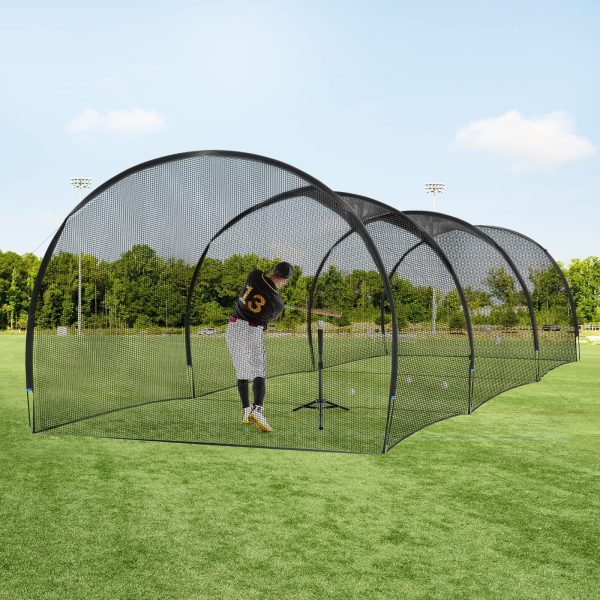
Polyester Baseball & Softball Batting Cage Net Consistent Rebound, Lasting Strength
Made from high-tenacity knotless polyester, this batting cage net offers exceptional tensile strength, consistent rebound control, and long-lasting outdoor durability. Its UV-stabilized finish ensures reliable performance under continuous sunlight and high-impact use, making it ideal for professional and training facilities.
HDPE is certainly not a weak material. Its high density provides significant strength. However, it is more rigid. It behaves more like a solid wall than a flexible catch. While perfectly adequate for containing slower-moving balls or for use as a general barrier, it has a lower breaking point under the kind of sharp, high-velocity impacts that define golf and baseball. A net made from HDPE will stop the ball, but the material itself is placed under greater stress with each impact compared to Nylon.

Heavy-Duty Polyethylene Baseball Barrier Net for Field Protection
Our barrier fencing net is designed to withstand the rigors of outdoor environments and high impact, ensuring long service life and reliable protection
Environmental Resistance: The War Against Weather
A sports net, particularly one installed outdoors, is in a constant battle with the elements. Sunlight, rain, humidity, and temperature fluctuations are relentless adversaries. How a material withstands this siege determines its functional lifespan and, ultimately, its long-term cost.
The Challenge of UV Radiation
Sunlight contains ultraviolet (UV) radiation, which is a form of high-energy light that can break down the chemical bonds in polymers. This process, known as photodegradation, makes the material brittle, weak, and prone to failure.
HDPE is the clear winner in this category. Its stable hydrocarbon structure is inherently resistant to UV radiation. While all plastics will eventually degrade with enough sun exposure, HDPE holds up exceptionally well, maintaining its strength and flexibility for many years even in sunny climates like Florida, California, or Australia.
Nylon, by contrast, is quite susceptible to UV degradation. Unprotected Nylon fibers can lose a significant percentage of their tensile strength within a single year of direct sun exposure. To counteract this, Nylon netting for outdoor use is always treated with UV inhibitors. These are chemical additives that absorb or reflect UV radiation, protecting the polymer chains. However, these inhibitors are sacrificial; they break down over time, and once they are gone, the Nylon itself begins to weaken. This makes the quality and thickness of the UV treatment a critical factor in the longevity of a Nylon net.
The Problem of Water Absorption
Water presents another significant challenge, particularly in regions with high rainfall or humidity.
HDPE is hydrophobic—it repels water. It absorbs virtually no moisture. This means an HDPE net’s weight and dimensions remain stable regardless of the weather. It will not sag after a rainstorm or become heavier, which reduces the stress on the supporting structure and cables.

Reinforced HDPE Scaffold Debris Containment Protection Safety Netting
Built with reinforced HDPE and a close-mesh design, this scaffold debris netting delivers durable, weather-resistant, and highly effective containment performance across demanding construction environments.
Nylon is hydrophilic—it attracts and absorbs water. When Nylon fibers get wet, water molecules work their way between the polymer chains, causing the fibers to swell and elongate. A wet Nylon net can absorb up to 10% of its weight in water, causing it to sag significantly. As it dries, it may shrink, but often not back to its original dimensions, leading to inconsistent tension. This repeated cycle of stretching and shrinking accelerates wear and can put unpredictable stress on the installation hardware. Furthermore, perpetually damp conditions can promote the growth of mold and mildew, which can further degrade the fibers unless the net is treated with a bonding or latex agent.
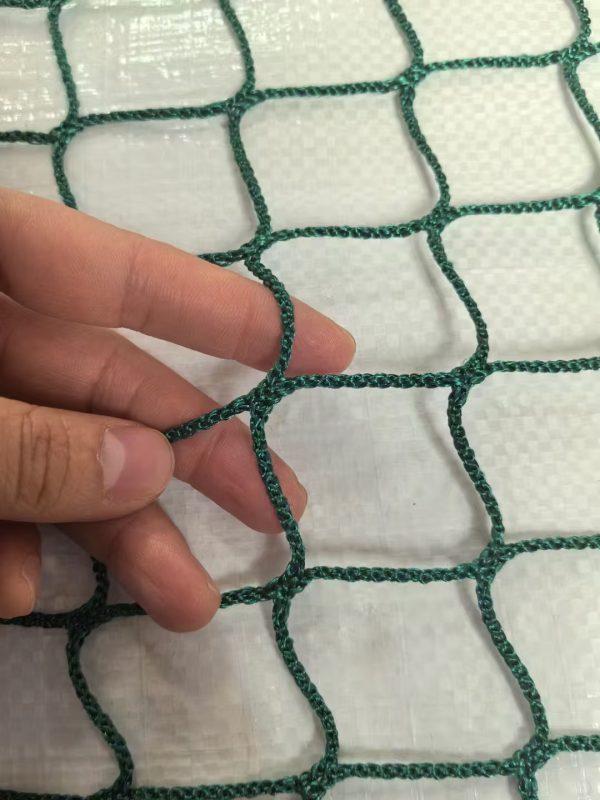
Red de seguridad duradera de nylon sin nudos - Anticaídas, red perimetral para pistas deportivas, barrera blanda y valla protectora
Specification
-
Material: High-strength Nylon (Knotless)
Cost Analysis: Initial Outlay vs. Lifetime Value
For any procurement manager, the budget is a primary consideration. At first glance, HDPE often appears to be the more economical choice. The raw material is less expensive, and the manufacturing process is generally simpler, leading to a lower price per square foot.
However, a sophisticated cost analysis looks beyond the initial purchase price to the total cost of ownership over the net’s entire lifespan. Let’s consider a hypothetical scenario for a large outdoor barrier net at a golf driving range in a sunny, rainy climate.
| Cost Factor | Nylon Netting (with UV & Weather Treatment) | HDPE Netting |
|---|---|---|
| Initial Cost | $2.00 per sq. ft. | $1.50 per sq. ft. |
| Estimated Lifespan | 5-7 years | 10-15 years |
| Replacement Cycle | Requires replacement at least once in a 15-year period. | May last the entire 15-year period. |
| 15-Year Material Cost | $2.00 (initial) + $2.00 (replacement) = $4.00 per sq. ft. | $1.50 per sq. ft. |
| Associated Costs | Labor for replacement, potential downtime for the facility. | Minimal maintenance, no replacement labor costs. |
In this scenario, the initially cheaper Nylon net could end up being more than twice as expensive over a 15-year horizon due to its shorter lifespan in an outdoor environment. The calculation must account for not only the material cost but also the labor for removal and re-installation, and the potential loss of revenue if a facility has to close for maintenance.
Therefore, the most “economical” choice is not about the lowest initial price, but about the material that provides the required performance for the longest time in its specific environment. For permanent outdoor installations, HDPE often presents a superior return on investment.
Application-Specific Scenarios: Matching Material to Sport
The theoretical discussion of material properties becomes most valuable when applied to real-world situations. The optimal choice between HDPE and Nylon is rarely universal; it is contingent upon the specific demands of the sport and the setting.
For High-Impact Sports: Golf and Baseball
- Primary Challenge: Extreme, focused impact energy.
- Recommendation: Nylon is generally the superior choice for the primary impact zones.
- Reasoning: As discussed, Nylon’s higher tensile strength and elasticity allow it to absorb the violent, repeated impacts from golf balls and baseballs more effectively than HDPE. This reduces ball rebound and extends the life of the net where it matters most. For a baseball batting cage or a golf practice bay, the impact panel that takes the direct hits should ideally be made of a heavy-grade, treated Nylon. As a leading provider of custom sports netting, we recognize that using the right material in the right place is key to safety and durability.
For Large-Area Barrier Netting: Soccer, Lacrosse, and Driving Range Perimeters
- Primary Challenge: Containing errant balls over a large area, often outdoors.
- Recommendation: HDPE is often the more strategic and cost-effective choice.
- Reasoning: These nets are less about absorbing a single, violent impact and more about providing a durable, weatherproof barrier. The balls are larger, often slower, and the impacts are distributed over a wider area. Here, HDPE’s strengths shine. Its light weight reduces the structural load and cost of the required poles and cables, which is a major factor for very large nets. Its superior UV and moisture resistance means it will not sag, rot, or degrade, providing a maintenance-free solution for many years (U.S. Netting, 2022). A 300-foot long, 50-foot high barrier net for a driving range is a massive capital investment, and choosing HDPE can double its functional lifespan compared to Nylon.
For All-Weather Outdoor Venues
- Primary Challenge: Constant exposure to sun, rain, and humidity.
- Recommendation: HDPE is almost always the preferred material.
- Reasoning: Any permanent outdoor installation must prioritize environmental stability. Nylon’s tendency to absorb water and degrade under UV light makes it a high-maintenance and short-lived option unless the budget allows for frequent replacement. HDPE’s inherent resistance to these factors ensures the net maintains its integrity and appearance for a decade or more, representing a far better long-term investment.
For Indoor Facilities
- Primary Challenge: No environmental pressures; focus is on strength and performance.
- Recommendation: Nylon is an excellent choice.
- Reasoning: In a climate-controlled indoor environment, Nylon’s two main weaknesses—UV sensitivity and water absorption—are completely negated. Facility managers can therefore capitalize on its primary strength: impact absorption. An indoor batting cage or golf simulator can use Nylon netting to provide the best possible performance and safety without any concern for weather-related degradation. The higher initial cost is justified by its superior performance in this protected setting.
Beyond the Fiber: The Role of Net Construction and Treatment
Choosing between HDPE and Nylon is the first and most important step, but it is not the only one. The performance of the final product is also deeply influenced by how the fibers are made into a net and what treatments are applied. A knowledgeable supplier should guide you through these choices.
Twine Construction: Twisted vs. Braided

- Twisted Twine: This is the most common and cost-effective construction. Multiple strands of fiber are simply twisted together to form the twine. It is strong and reliable, but it can unravel over time, and the twisting process can create internal abrasion.
- Braided Twine: In this method, fibers are interwoven in a diamond or solid braid pattern, much like a rope. This creates a stronger, smoother, and more durable twine. It has superior abrasion resistance and a higher break strength than a twisted twine of the same diameter. Braided construction is a premium feature that significantly enhances the longevity of any net, whether it’s made of HDPE or Nylon.
Coatings and Treatments

- UV Inhibitors: As mentioned, this is non-negotiable for outdoor Nylon nets. The quality and concentration of the treatment determine the net’s lifespan.
- Bonding/Dipping: Many nets are dipped in a latex or other bonding agent. This treatment serves multiple purposes. It locks the knots in place, preventing them from slipping. It adds a layer of abrasion resistance, protecting the underlying fibers. For Nylon, it also helps to seal the fibers from moisture, reducing water absorption and sag. The color of the net is typically part of this coating. A black coating is most common as the carbon black pigment used is itself an excellent UV blocker.
Understanding these secondary factors is crucial. A high-quality braided HDPE net could potentially outperform a low-quality twisted Nylon net even in some impact scenarios. This is why partnering with an experienced manufacturer who can explain these nuances is so important.
A Strategic Framework for Your Final Decision
As a procurement manager, your task is to synthesize these technical details into a clear, defensible decision. Here is a step-by-step framework to guide your thinking, modeled on the needs of a professional like Robert from Canada, who sources nets for golf courses.

- Define the Primary Function: Is the net’s main job to stop high-velocity projectiles at close range (impact panel) or to serve as a general perimeter barrier? For Robert’s golf driving range projects, he needs both.
- Assess the Environment: Will the net be indoors or outdoors? If outdoors, what is the climate? Canada has harsh winters and significant UV exposure in the summer. This points toward materials with excellent weather stability.
- Analyze the Impact Type: For the main driving range barrier, the impacts are frequent but distributed. For the individual practice bays, the impacts are concentrated and intense.
- Calculate the Lifetime Value: Robert’s pain point is slow supply chains and project delays. A net that lasts 15 years (HDPE) instead of 7 (Nylon) eliminates one full replacement cycle. This means no project delays, no additional labor costs, and no facility downtime. The higher long-term value of HDPE for the main barrier becomes clear.
- Develop a Hybrid Solution: The most sophisticated approach is often not an “either/or” choice. For Robert’s golf range, the optimal solution would be a hybrid system:
- Main Barrier Netting: Use a high-grade, braided HDPE for the entire perimeter. This maximizes longevity, minimizes maintenance, and provides the best return on investment for the largest part of the project.
- High-Impact Panels: For the first 20-30 yards of the range where impacts are hardest, install a separate, heavy-duty Nylon impact panel in front of the main HDPE net. This panel is designed to be a sacrificial, high-performance component. It leverages Nylon’s superior strength where it is most needed. It can be replaced every 5-7 years at a fraction of the cost of replacing the entire barrier.

This hybrid strategy allows you to leverage the best properties of both materials, creating a system that is safe, durable, and financially astute. It directly addresses the need for both high performance and long-term durability.
Preguntas más frecuentes (FAQ)
Which material is better for a golf driving range net?
For the large perimeter barrier net, HDPE is the superior choice due to its excellent UV resistance, light weight, and resistance to moisture, which translates to a much longer lifespan and lower lifetime cost. For the close-range impact panel that takes the hardest hits, a heavy-duty Nylon net is recommended for its superior ability to absorb energy.
Is Nylon stronger than HDPE?
Yes, pound for pound, Nylon has a higher tensile strength and breaking point than HDPE. This makes it better at handling the sudden, high-energy impacts of sports like golf and baseball.
Why does my Nylon net sag when it rains?
Nylon is hydrophilic, meaning it absorbs water. When the fibers become saturated with moisture, they swell and stretch, causing the net to get heavier and sag under its own weight. HDPE does not absorb water and remains dimensionally stable in all weather conditions.
Can I get HDPE and Nylon nets in different colors?
Yes, both materials can be dyed or coated to come in various colors. Negro is the most common and recommended color for outdoor use because the carbon black pigment used in the coating is an excellent UV blocker, adding an extra layer of protection to the net fibers.

How does the twine size (e.g., #18, #36) relate to the material?
The twine number indicates its thickness and break strength.
A higher number means a thicker, stronger twine. A #36 Nylon twine will be significantly stronger than a #18 Nylon twine. The same numbering system applies to HDPE. When comparing materials, you should compare twines of a similar break strength, not necessarily the same number, as a #24 Nylon might have a similar break strength to a thicker HDPE twine.
Is one material more environmentally friendly?
Both HDPE and Nylon are petroleum-based plastics. HDPE is more widely and easily recycled (Recycle #2) than Nylon (Recycle #7), which can be a consideration for some projects. However, the most significant environmental factor is longevity. A net that lasts twice as long, like HDPE in an outdoor setting, consumes half the resources over its functional life.
What is the most important factor when choosing between HDPE and Nylon?
The single most important factor is the intended application environment. If the net will be outdoors and exposed to sun and rain, HDPE’s environmental stability is its most compelling advantage. If the net is indoors or for a short-term application, Nylon’s superior strength can be prioritized.

The deliberation between High-Density Polyethylene and Nylon for sports netting is not a simple contest with a single victor. Rather, it is an exercise in aligning material science with practical need. The examination reveals that each polymer possesses a distinct profile of virtues and vulnerabilities.
Nylon, with its remarkable tensile strength and capacity for energy absorption, stands as the preeminent choice for zones of high-velocity impact, provided it is shielded from the persistent degradation of weather. HDPE, conversely, presents a compelling case for permanence and endurance, its inherent resistance to ultraviolet light and moisture making it the logical and financially prudent selection for large-scale, long-term outdoor installations.

A truly strategic approach, therefore, transcends a binary choice and embraces a nuanced, application-specific solution.
It may involve the thoughtful combination of both materials within a single facility to create a system that is at once resilient, safe, and economically sound. The ultimate wisdom lies not in declaring one material superior, but in understanding the context so thoroughly that the material, in essence, chooses itself.

Lea nuestros artículos más populares.
👉 Descargue gratuitamente nuestras categorías de productos
👉 The Ultimate Guide to Installing Anti-Insect Nets in Greenhouses
👉 The Ultimate Guide to Choosing the Right Cargo Netting for Your Fleet
👉 HDPE vs Nylon Sports Netting: The Ultimate Guide
👉 A 5-Step Expert Guide: “Made to Order”: A Look at Our Custom Netting Process
👉 Cómo Empezar un Negocio de Redes de Marca Propia: Un marco de trabajo en 5 pasos
👉 La fabricación china frente a los proveedores locales: Guía del comprador de redes