
This article provides a practical, engineering-focused overview of ASTM standards as they apply to sports netting systems. It covers the core technical requirements that define safe and reliable netting, including material strength, projectile containment, fire retardancy for indoor applications, installation integrity, and long-term maintenance.

Rather than treating standards as abstract technical documents, this guide explains how they affect real-world decisions for facility managers, contractors, athletic directors, and procurement teams. It also examines the practical value of ASTM compliance in reducing liability, improving user safety, and extending the service life of sports safety netting.
Finally, it places ASTM standards within a broader global framework, helping buyers understand how American standards compare with international approaches when sourcing and specifying custom netting solutions.
Key Takeaways
- Verify material strength using recognized testing methods to ensure long-term durability.
- Match mesh size to the specific projectile size and impact profile of each sport.
- Require fire-retardant certification, especially NFPA 701 compliance, for indoor sports netting.
- Treat cables, anchors, poles, and connectors as critical parts of the overall safety system.
- Implement structured inspection and maintenance protocols instead of relying on age alone.
- Maintain documentation for purchasing, installation, inspection, and repair to reduce liability exposure.
Understanding the Landscape of Sports Safety: Why Standards Matter
Athletic performance takes place inside environments that are expected to be safe by design. Players, spectators, coaches, and facility operators all assume that a baseball backstop will stop a line drive, that a golf barrier net will protect adjacent walkways, and that an indoor training space will meet basic fire safety requirements.

Those expectations are not accidental. They depend on engineering judgment, product quality, installation integrity, and standards that define acceptable performance. In that sense, sports netting is not just a piece of equipment. It is a safety system that exists to prevent foreseeable harm.
This is why standards matter. They turn general ideas about safety into measurable requirements. They define how strong a net should be, how small the mesh opening should be for a given projectile, how indoor materials should behave in a fire event, and how the overall system should be installed and maintained.
The Human Element Behind Safety Standards
Safety standards are often viewed as technical specifications, but their real purpose is human protection.
When discussing ASTM standards for athletic netting systems, the conversation is not only about twine diameter, polymer type, or hardware selection. It is about the difference between a routine game and a preventable injury. That perspective changes net selection from a simple purchasing decision into a risk management decision.
From Reactive Safety to Engineered Protection
Historically, many sports safety measures were reactive. A barrier was added after an incident. Materials were selected based on availability. Installation decisions were made through rule of thumb rather than engineering analysis.

Modern safety expectations are different. Today, facility operators are expected to make informed, proactive decisions. Standards support this shift by providing a framework for evaluating backstop netting, barrier netting, divider netting, and other sports net systems based on performance, not assumption.
What Is ASTM International?
ASTM International is a global standards development organization that brings together engineers, manufacturers, researchers, consultants, and end users to create consensus-based technical standards. It is not a government agency, and it does not directly create law. Its influence comes from the credibility of its process and the broad acceptance of its standards across industries.
For buyers and specifiers, ASTM standards provide a common technical language. They make it easier to compare products, define acceptable performance, and communicate expectations clearly with suppliers and installers.
Point 1: Material Strength and Durability
At the most basic level, a safety net must be able to withstand impact without failing. If the material breaks under normal use conditions, the system cannot perform its intended function.
The Science of Tensile Strength
Material strength is not a marketing claim. It is measured through standardized testing. In a tensile strength test, a sample of twine is placed in a testing machine and pulled under increasing force until it breaks. The resulting break strength value provides an objective measure of how much force the material can withstand.
For sports backstop netting and other impact-driven applications, this value is essential. It forms the foundation for comparing products and evaluating whether the material is appropriate for the expected load.
Why Knot Strength Matters
A net is not just a strand of twine. It is a system of intersections, and in knotted netting each knot becomes a stress concentration point. That means the knot area is typically weaker than the straight twine itself.
For that reason, buyers should not evaluate only straight-twine strength. They should also understand how the net performs at its intersection points. A high-quality net will retain as much strength as possible at the knot or, in the case of knotless netting, through a well-engineered continuous structure.
Three Core Variables: Material, Diameter, and Construction
The strength and durability of protective sports netting depend on three primary variables:
- Material type
- Twine diameter
- Construction method
Material Type
The most common materials used in modern sports netting are nylon, polyester, and polyethylene.
Nylon (Polyamide) is known for high strength, good elasticity, and strong shock absorption. It performs well in high-impact environments such as baseball and softball backstops, although it generally requires UV treatment for long-term outdoor use.
Polyester (PET) offers strong mechanical performance with better UV resistance and lower moisture absorption. It is often preferred for permanent outdoor installations where durability and dimensional stability are especially important.
Polyethylene (PE / HDPE) is lightweight, economical, and resistant to moisture and mildew. It is commonly used in lighter-duty barrier applications, though it typically does not match nylon or polyester in overall strength.
Twine Diameter
Twine diameter directly affects strength. Thicker twine generally provides higher break strength, but the correct diameter depends on the application. A professional baseball backstop requires a heavier construction than a light recreational barrier or divider net.
Construction Method
Construction also influences performance. Twisted twine is common and effective, while braided construction often offers a smoother, more durable finish and is frequently used in premium applications. Construction quality affects consistency, wear resistance, and long-term service life.
Environmental Resistance and Long-Term Durability
Initial strength is only part of the performance equation. Outdoor sports netting systems are exposed to UV radiation, moisture, wind, abrasion, and temperature cycling. Over time, these environmental forces reduce performance.
UV exposure is particularly important because it breaks down polymer chains and gradually reduces tensile strength. This can lead to fading, stiffness, brittleness, and ultimately failure if the wrong material is selected.
That is why reputable manufacturers use UV stabilizers or protective treatments, especially for outdoor baseball, golf, tennis, and multi-sport netting applications. Polyester has a natural advantage in UV resistance, while nylon generally needs treatment to achieve comparable outdoor durability.
Why Material Selection Failures Happen
A net may perform well when new and still fail prematurely if the material is not suited to the environment. For example, low-grade untreated polyethylene installed in a high-UV location may look acceptable at first, then become faded, brittle, and structurally unreliable after prolonged exposure. That is not simply a product aging issue. It is a specification failure.
Point 2: The Physics of Containment — Mesh Size and Projectile Control
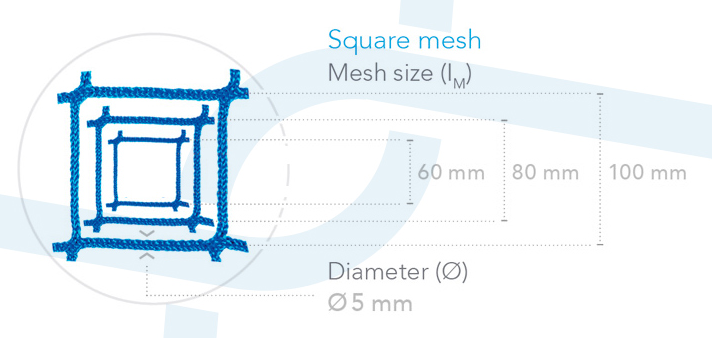
If material strength determines whether a net can withstand impact, mesh size determines whether it can contain the object in the first place. A net can be made from very strong fiber and still fail immediately if the openings are too large for the projectile it is supposed to stop.
The Core Principle of Mesh Selection
The most basic rule is simple: the mesh opening must always be smaller than the projectile it is designed to contain. This sounds obvious, but it is one of the most common causes of safety failure, especially in facilities that try to use one type of netting for multiple sports.
Why Projectile Behavior Matters
Each sport has its own containment profile. Golf balls are small and extremely fast. Baseballs carry high kinetic energy. Hockey pucks are dense and heavy. Soccer balls are much larger and typically require a different netting strategy. Proper sports barrier netting design must consider projectile size, speed, momentum, and expected impact conditions.
Mesh Size Is a Balancing Decision
Smaller mesh openings improve containment, but they also increase weight, material use, visual obstruction, and wind load. The correct design is not simply the smallest possible mesh. It is the smallest mesh that safely performs the containment function without creating unnecessary cost or structural burden.
Recommended Mesh Sizes for Common Sports
| Sport | Projectile | Typical Diameter | Recommended Mesh Size | Common Materials |
|---|---|---|---|---|
| Golf | Golf Ball | 1.68 in (42.7 mm) | 0.75 – 1.0 in | Nylon, Polyester, HDPE |
| Baseball / Softball | Baseball / Softball | 2.9 / 3.8 in | 1.75 – 1.8 in | Nylon, Polyester, HDPE |
| Hockey | Hockey Puck | 3.0 in (76 mm) | 1.5 – 1.75 in | Nylon, Polyester |
| Lacrosse | Lacrosse Ball | 2.5 in (64 mm) | 1.5 – 1.75 in | Nylon, Polyester |
| Soccer | Soccer Ball | 8.6 in (220 mm) | 4.0 – 5.0 in | Polyester, HDPE |
| Tennis | Tennis Ball | 2.6 in (67 mm) | 1.75 in | Polyester, HDPE |
| Pickleball | Pickleball | 2.9 in (74 mm) | 1.75 – 2.0 in | Polyester, HDPE |
The Danger of One-Size-Fits-All Netting
One of the most common specification mistakes is using a single mesh size across multiple applications. For example, a 4-inch mesh designed for soccer is completely inappropriate for lacrosse, because a lacrosse ball can pass through it easily. In that case, the net has not underperformed. It has failed by design.
This is why custom sports netting is often necessary. Baseball backstop netting, golf impact netting, lacrosse barriers, and pickleball dividers may all look similar from a distance, but they are designed around different safety requirements.
baseball backstop netting guide and golf barrier netting.
Point 3: Fire Retardancy and Indoor Safety
When sports netting is installed indoors, fire behavior becomes a critical safety factor. In enclosed environments such as gymnasiums, field houses, training centers, and multi-sport facilities, synthetic netting is part of the overall fire risk profile of the building.
Why Fire Performance Matters
If indoor netting ignites easily or contributes to flame spread, it can accelerate fire growth, increase smoke generation, and create serious evacuation hazards. That is why indoor netting should not be selected on strength and mesh size alone. Fire performance must be part of the specification process.
NFPA 701 as the Primary Benchmark
In the United States, the most widely recognized benchmark for flame propagation in fabrics and films is NFPA 701. This standard evaluates how a material behaves when exposed to flame, including whether it continues to burn after the flame source is removed and how far the damage spreads across the sample.

For indoor gym divider netting, batting cage netting, and related applications, NFPA 701 compliance is often a baseline requirement.
Why Documentation Matters
Buyers should never rely on vague claims such as fire treated or fire safe without verification. They should request formal test reports or certification documents that clearly reference NFPA 701 compliance. Without documentation, there is no reliable basis for assuming acceptable fire performance.


Treated vs. Inherently Fire-Retardant Materials
Fire-retardant performance can be achieved in two general ways. Some products use a topical treatment applied after manufacturing. Others use fibers with inherent fire-retardant properties built into the material itself.
Topical treatments may be effective, but long-term durability can depend on wear, cleaning, and exposure conditions. Inherently fire-retardant materials generally provide more stable long-term performance, which is especially valuable in permanent indoor installations.
Point 4: Installation Integrity — The System Behind the Net
A sports net is only one part of the safety system. Its real-world performance depends on the quality of the supporting structure, cable system, anchors, connectors, and installation method.
Why Installation Is a Safety Issue
When a ball or puck impacts a net, the load is transferred through the entire system: from the netting itself into the cables, then into the anchors and structural supports. If any one of those components is underspecified or poorly installed, the failure can occur outside the fabric itself.
That is why installation should never be treated as a minor follow-up step. It is an engineering requirement.
Key Components of the Installation System
- Support structure: poles, framing, or building attachment points
- Cable system: galvanized or stainless steel load-bearing cables
- Anchors and fixings: mechanical or chemical anchors sized for the load
- Connectors and hardware: clips, shackles, hooks, and tensioning components
Each of these must be selected with the same attention given to the net itself.
Hardware Material Comparison
| Hardware Component | Galvanized Steel | Stainless Steel (Type 304) | Stainless Steel (Type 316) |
|---|---|---|---|
| Description | Steel with zinc coating for corrosion protection | Stainless alloy with good general corrosion resistance | Marine-grade stainless with superior corrosion resistance |
| Corrosion Resistance | Good, but coating can wear over time | Very good for most outdoor conditions | Excellent for coastal, high-humidity, or corrosive environments |
| Initial Cost | Low | Medium | High |
| Lifecycle Cost | Medium to high in harsh environments | Low to medium due to long service life | Low over time because of maximum durability |
| Best For | Indoor use, dry climates, budget-sensitive projects | Most outdoor sports netting installations | Coastal, poolside, humid, or highly corrosive environments |
Wind Load and Sag
Two installation concerns are especially important in outdoor applications: sag and wind load.
Sag is the natural droop in a suspended cable or net. Excessive sag can reduce usable protection area, create inconsistent performance, and increase wear at certain points. Proper cable sizing and tensioning are required to control it.
Wind load is critical for large outdoor netting systems such as golf driving range barriers and perimeter sports nets. A large net can behave like a sail and generate significant force on poles, anchors, and cables. Installation design must account for expected local wind conditions and system geometry.
Installation Should Be Professionally Engineered
A quality installation starts with structural review, correct hardware selection, load path planning, and proper tensioning. Field improvisation is not an acceptable substitute for design. In safety applications, the net, hardware, and structure must be treated as one coordinated system.
Point 5: Inspection, Maintenance, and the Lifecycle of Safety
The installation of a netting system is the beginning of the safety process, not the end. Netting performance changes over time due to impact, weather, abrasion, and hardware wear. That is why a proactive inspection and maintenance program is essential.
Service Life Is Not Just About Age
The lifespan of outdoor sports netting depends on more than time. It is influenced by usage intensity, UV exposure, moisture, material quality, and installation quality. A heavily used professional training net may wear out much faster than a lightly used recreational system, even if both were installed on the same date.
Recommended Inspection Levels
- Pre-use visual checks: quick scans before games or training sessions
- Formal periodic inspections: monthly or quarterly reviews of fabric, cables, anchors, and hardware
- Annual professional inspection: detailed evaluation by a qualified installer or netting specialist
Common Failure Points
During inspections, attention should be given to:
- High-impact zones where repeated ball contact causes wear
- Attachment points and border rope areas under constant stress
- Net sections near the ground where abrasion or landscaping damage may occur
- Seams between panels
- Corroded clips, clamps, turnbuckles, or cables
Documentation as Risk Management
A strong documentation record is one of the most important tools for liability protection. Facility operators should keep organized records of product specifications, installation details, inspection reports, repairs, maintenance activity, and relevant certifications such as NFPA 701 for indoor applications.
This documentation demonstrates due diligence and supports a defensible safety program.
Navigating the Global Context: ASTM and International Standards
Although ASTM standards are especially influential in the United States, sports netting is a global market. Buyers often compare products from multiple countries, and suppliers may manufacture to ASTM, European EN standards, or other regional specifications.
Are ASTM Standards Legally Binding?
ASTM standards are typically voluntary on their own. However, they may become effectively mandatory when incorporated into building codes, procurement documents, insurance requirements, or project contracts. Even when not directly written into law, they often define the industry standard of care used to evaluate reasonable safety practice.
ASTM vs. European Standards
European standards, commonly identified as EN standards, serve a similar purpose in Europe. The exact methods and values may differ, but the principles are often aligned: material strength, product durability, user safety, and fitness for purpose.

Sourcing Globally Without Sacrificing Compliance
When sourcing from international suppliers, buyers should be specific in their requirements. They should identify the exact standard needed, request third-party test reports, confirm material equivalency, and ask about manufacturing quality control. A reliable supplier should be able to provide technical documentation rather than unsupported claims.
Frequently Asked Questions
How often should sports netting be replaced?
There is no single replacement schedule that applies to every facility. The correct approach is to inspect netting regularly and replace it when it shows significant degradation, such as brittleness, heavy abrasion, multiple tears, or loss of structural reliability.
Is nylon or polyester better for outdoor backstop netting?
Both can perform well, but they serve slightly different priorities. Polyester typically offers better UV resistance and lower moisture absorption, making it an excellent choice for long-term outdoor installations. Nylon offers excellent shock absorption and impact performance, but it should be properly UV-treated for outdoor use.
What is the difference between knotted and knotless netting?
Knotted netting uses tied intersections, while knotless netting uses a continuous woven or knitted structure. Knotless netting often offers a smoother surface and can reduce wear at intersections, though both styles can perform well when properly manufactured for the application.
Can small holes in sports netting be repaired?
Yes, small holes should be repaired as soon as possible to prevent further enlargement. Repairs should use matching material and twine size. Larger tears or damage in high-impact zones may require full panel replacement.
Does net color affect performance?
Color does not directly determine strength, but black netting is popular because carbon black pigment helps improve UV resistance and often offers better visual transparency from the spectator perspective.
What does twine gauge mean?
Twine gauge or twine number indicates thickness and generally corresponds to strength. Because naming systems vary by manufacturer, buyers should also request actual twine diameter and rated break strength for accurate comparison.
Why is stainless steel hardware more expensive than galvanized steel?
Stainless steel contains alloying elements that provide stronger, more durable corrosion resistance throughout the material, not just as a surface coating. In outdoor or coastal projects, the higher initial cost is often justified by longer service life and lower maintenance needs.
Conclusion
ASTM standards for sports netting provide much more than technical guidance. They create a framework for making better safety decisions. By understanding material strength, selecting the correct mesh size, requiring indoor fire performance, treating installation as part of the engineering system, and maintaining a disciplined inspection program, facility operators can move beyond basic purchasing and toward true safety management.
The most important takeaway is simple: sports netting should not be treated as a commodity product. It should be specified, installed, and maintained as a complete protective system designed for the actual risks of the environment.
For schools, sports complexes, stadiums, training centers, and contractors, that approach leads to better safety outcomes, stronger liability protection, and more reliable long-term performance.

Read our most popular articles.
👉 Download our free product categories
👉 A 15-Point Practical Guide: The Complete Checklist for Sports Netting Installation
👉 Beyond Breaking Strength: A Comprehensive Guide to Netting ion, Safety, and Risk Management
👉 5 Reasons Why Durable, Long-Lasting Products are the New Definition of “Cost-Effective”
👉 The True Cost of Cheap Netting: A Total Cost of Ownership Analysis
👉 UV Stabilizers in Sports Netting: A Comprehensive Guide to Longevity