
Improving spectator safety at professional sporting events has become a major priority, especially in Major League Baseball stadiums, where foul balls and broken bats can pose a serious risk to fans.
Recent stadium protection projects make one point clear: an effective safety upgrade involves much more than extending a net. It begins with a detailed risk assessment that combines projectile analysis with a precise review of the seating areas most exposed to danger, often well beyond the traditional backstop. From there, material selection becomes a key decision. Modern stadiums increasingly rely on knotless ultra-high-molecular-weight polyethylene (UHMWPE) netting because it offers exceptional strength in a thinner profile, helping preserve sightlines while still providing dependable protection. The final phase requires careful engineering and installation, including digital modeling, load calculations, and specialized rigging methods to integrate the system cleanly into the stadium structure.

Taken together, this project spotlight shows that securing a major league baseball stadium is a highly methodical process—one that must meet rising safety expectations without compromising the fan experience.
Key Takeaways
- Conduct a comprehensive risk analysis to map high-velocity projectile trajectories and identify all vulnerable seating areas.
- Select advanced, thin-gauge UHMWPE netting to maximize spectator visibility while ensuring superior impact resistance.
- Utilize digital modeling and professional engineering for precise cable tensioning and system integration.
- A successful project spotlight: securing a Major League Baseball stadium hinges on balancing safety with fan experience.
- Implement a long-term inspection and maintenance protocol to guarantee the system’s integrity over time.
- Prioritize knotless netting designs to eliminate visual distortion and improve the viewing experience for fans.
Step 1: Comprehensive Site Assessment and Risk Analysis
Securing a venue as large and operationally complex as a Major League Baseball stadium does not start with installation. It starts with an investigation. Before any netting is designed or installed, the facility must be evaluated as a dynamic environment shaped by speed, trajectory, architecture, and human behavior. Safety cannot be treated as a box to check; it has to be engineered around the actual risks present in the space.

This first phase is often the most demanding because it brings several disciplines together at the same time: physics, stadium design, regulatory review, and human-factors analysis. The objective is to build a detailed risk map of the spectator areas, identifying not only the obvious high-risk sections but also the less visible zones where timing, angle, and fan positioning can combine to create serious danger. Without that level of detail, any protection plan is based more on assumption than evidence, and that is not a position any responsible facility team should accept.
Understanding the Ballistics of Foul Balls and Broken Bats
At the center of any serious risk assessment is ballistics. A baseball coming off a professional hitter’s bat carries tremendous force. Foul tips can exceed 110 miles per hour (177 km/h) and reach the seats behind home plate in less than half a second, leaving spectators with virtually no time to react. That is why the analysis has to go far beyond general observation. It needs to account for a wide range of contact scenarios: the exit velocity of a topped foul ball compared with a sliced one, the effect of spin after impact, and the way the ball may ricochet off surrounding surfaces. A 2018 analysis found that the average foul ball entering the stands can travel with enough force to cause significant injury, underscoring just how limited spectator reaction time really is (Fast, 2018).

Broken bats add another layer of complexity. A fractured piece of maple can fly into the stands at high speed while tumbling unpredictably, creating a larger and less stable impact profile than a baseball. For that reason, the assessment also needs to account for how bats break, how fragments separate, and the likely flight paths of those pieces.

In practice, that means reviewing game footage, consulting materials experts who understand wood behavior, and applying physics to model trajectories that are inherently more chaotic. The goal is to move beyond anecdotal examples and develop a probability-based understanding of where these projectiles are most likely to land and how dangerous they may be. In many ways, it is similar to forecasting weather patterns—except the forecast is for impact risk inside the stadium. That kind of data-driven analysis forms the foundation of the entire safety project.
Mapping High-Risk Zones Beyond the Dugouts
For years, the common assumption was that only the seats directly behind home plate needed meaningful protection. Experience has shown that this view is too limited. The geometry of a modern ballpark, combined with the way foul balls travel, creates a much wider danger zone. A ball hit down the first- or third-base line rarely follows a simple straight path. It can slice sharply into the stands just beyond the dugout with very little warning. Areas once considered relatively low risk are now widely recognized as some of the most exposed.
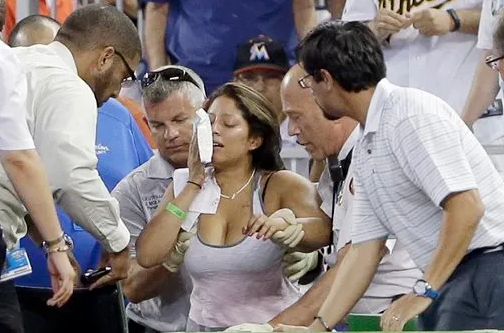
2 fans hit in face by foul balls at Marlins game
A proper site assessment uses ballistic data to build a seat-by-seat risk map of the stadium. Each section is typically categorized by risk level, taking into account factors such as distance from home plate, elevation, sightlines, and likely deflection angles from nearby structures. For example, a low line-drive foul ball down the line presents a very different risk from a high pop-up drifting back toward the field. The analysis should also consider hang time, spectator viewing angles, aisle placement, and concourse openings, all of which can influence how quickly fans perceive and react to incoming objects. In many cases, this level of analysis shows that the area requiring protective netting is much larger than initially expected—often extending to the foul poles and, in some ballparks, even beyond. It is a way of reading the stadium through the logic of physics rather than through the habits of tradition.
| Risk Zone Category | Typical Location | Average Foul Ball Speed (mph) | Estimated Spectator Reaction Time (seconds) | Recommended Netting Type |
|---|---|---|---|---|
| Extreme | Seats within 20 rows directly behind home plate | 95-115+ | < 0.4 | Ultra-High Strength, Thin Gauge UHMWPE |
| High | Sections above and immediately beyond dugouts | 80-100 | 0.5 – 0.8 | High Strength UHMWPE or Dyneema® |
| Moderate | Down the foul lines, approaching the foul poles | 65-85 | 0.8 – 1.5 | Standard Gauge Knotless Polyethylene |
| Low | Upper decks, far down the foul lines | < 65 | > 1.5 | Situational; may not require netting |
Regulatory Compliance and League Mandates
The evolution of safety standards in Major League Baseball reflects a broader shift from reactive measures to more proactive ones. After several well-publicized fan injuries, MLB issued recommendations in 2015 encouraging clubs to extend backstop netting to the near ends of both dugouts. At that stage, however, the guidance was still voluntary. By 2018, the league had moved to a formal mandate requiring all 30 teams to extend netting at least to the far end of each dugout.

All MLB teams to extend protective netting to far ends of dugouts
Any credible project assessment needs to do more than meet the current minimum requirement. It also needs to account for where standards are headed next. The broader industry trend has clearly been toward more extensive protection. By the start of the 2020 season, most teams had already chosen to go beyond the league requirement, with many extending netting from foul pole to foul pole. For project managers and stadium operators, that means reviewing not only MLB rules and recommendations but also applicable state and local code requirements for public venues. Doing so helps avoid future retrofits and ensures the design is compliant from the outset. It also makes sense to consult league facility operations teams and review how other clubs approached similar upgrades. In practice, that shared learning often leads to better decisions—not only in terms of compliance, but also in day-to-day usability and overall project quality.
Integrating Stakeholder Feedback: From Fans to Facility Managers
A stadium is not just a structure. It is an operating venue and a community environment. That means even a technically sound netting solution can fall short if it disrupts operations or creates unnecessary friction with fans. For that reason, the final part of the assessment phase needs to focus on stakeholder input and the practical realities of using the system over time.
Facility managers and maintenance teams should be involved early because they are the people who will work with the system every day. They need to think through questions such as how the netting will be raised, lowered, or removed for special events, and what cleaning and inspection routines will be required. Just as importantly, the voice of the fan should be built into the decision-making process. This can happen through surveys, focus groups, or even temporary mock-up sections using different netting materials so people can compare visibility and overall feel in a real-world setting.

Fans want safety, but they do not want to feel cut off from the game. Their concerns usually center on obstructed views, reduced player interaction, and the loss of traditional moments like catching a foul ball. Taking those concerns seriously is not just good public relations; it directly improves the final design. For example, if visibility is a recurring concern in a premium seating section, that may justify using a higher-end ultra-thin material in that area despite the added cost. In the best outcomes, this kind of dialogue turns the project from a top-down safety measure into a collaborative improvement that benefits everyone in the ballpark.
Step 2: Material Science and Custom Netting Specification
Once the assessment phase has established where protection is needed and why, attention shifts to the type of system that should be installed. This is where material science and engineering take center stage. The challenge is straightforward in principle but difficult in practice: create a barrier that is strong enough to stop dangerous impacts while remaining as visually unobtrusive as possible.

The netting material affects much more than safety. It influences visibility, lifespan, maintenance requirements, aesthetics, and overall project cost. The old model of hanging a thick, highly visible rope-style net is no longer acceptable in most high-level stadium environments. Modern netting systems are built around advanced polymer materials and more refined manufacturing methods, resulting in solutions that are stronger, thinner, and far less distracting to the eye. At this stage, success depends on carefully comparing product options, understanding the trade-offs, and specifying a system tailored to the stadium rather than settling for a generic off-the-shelf solution.
The Evolution from Nylon to Ultra-High-Molecular-Weight Polyethylene (UHMWPE)
The evolution of stadium netting closely tracks advances in polymer technology. For many years, nylon was the standard material because it offered reasonable strength, acceptable durability, and relatively manageable cost. But nylon has clear limitations in high-performance stadium applications. To stop a baseball traveling at around 100 mph, nylon twine typically needs to be fairly thick. That thickness—combined with the knots used in conventional net construction—creates noticeable visual obstruction. It also tends to degrade under long-term UV exposure and absorb water, which can increase sagging and reduce performance over time.

That is why UHMWPE has become such an important development in stadium protection. Sold under well-known trade names such as Dyneema® and Spectra®, UHMWPE is made with extremely long molecular chains that improve load transfer and produce one of the highest strength-to-weight ratios among synthetic fibers. On an equal-weight basis, it can be up to 15 times stronger than steel. In practical terms, that means a UHMWPE twine can be much thinner than nylon while still delivering equal or greater breaking strength.
| Rope Material | Key Features | Tensile Strength | Elongation | Abrasion Resistance | UV Resistance | Chemical Resistance | Application Examples |
|---|---|---|---|---|---|---|---|
| UHMWPE | Ultra-lightweight, buoyant | Exceptional (15x stronger than steel by weight) | Low (3-4%) | Excellent | Good | Excellent | Marine, winches, lifting, extreme sports |
| Nylon | Soft, pliable, shock-absorbing | Strong (moderate compared to UHMWPE and Kevlar) | High (25-30%) | Good-Excellent | Fair-Good | Good | Mooring lines, anchor lines, tow ropes |
| Kevlar | Flame & heat-resistant, non-conductive | Outstanding (5x stronger than steel by weight) | Very low (2%) | Excellent | Excellent | Good | Hot air balloons, rescue lines, electrical applic |
A high-performance stadium net may use UHMWPE twine as thin as 1.2 millimeters while still handling very high loads. That reduction in diameter makes a major difference in sightlines, helping the net visually recede so fans remain more connected to the game.
Balancing Strength, Visibility, and Environmental Resistance
Choosing the right material is always a balancing act. Strength, visibility, and long-term durability all matter, and improving one factor can sometimes affect another. Traditional materials typically force a compromise between strength and visual performance, but UHMWPE improves that equation significantly by offering high strength at much smaller diameters. Even so, not every UHMWPE option is the same. Different grades, constructions, and gauges still need to be evaluated carefully.
In practice, the project team has to choose a twine size that provides a comfortable safety margin for expected impact loads without becoming unnecessarily visible. At the same time, the material has to perform well outdoors over many years. Stadium netting is constantly exposed to sunlight, rain, humidity, temperature swings, and wind.
UHMWPE performs well under these conditions because it resists UV degradation and does not absorb water, helping it maintain its strength and shape over time.
Net color is another important detail that is often misunderstood. While some people assume lighter colors would be less visible, black is generally preferred because it reflects less light. As a result, the eye can focus more easily on the brighter field beyond the net. It is the same effect that makes a dark screen seem to disappear against a bright background. In real-world stadium use, that optical advantage is significant. It is also one reason why working with a supplier that offers custom netting solutions can be valuable when trying to optimize the balance between impact protection, visibility, and service life.
| Material | Tensile Strength | Twine Diameter (Typical) | UV Resistance | Visibility | Relative Cost |
|---|---|---|---|---|---|
| Nylon | Good | 2.5mm – 4.0mm | Fair (Degrades over time) | Poor to Fair | Low |
| Polyester | Good | 2.0mm – 3.5mm | Good | Fair | Moderate |
| HDPE | Moderate | 2.0mm – 3.0mm | Very Good | Fair to Good | Moderate |
| UHMWPE (Dyneema®) | Exceptional | 1.2mm – 2.2mm | Excellent | Excellent | High |
The Importance of Knotless vs. Knotted Netting
How the net is constructed matters almost as much as the fiber itself. Traditional nets are made by tying strands together at each intersection, which creates a grid of visible knots. That structure is functional, but the knots add bulk and make the pattern more noticeable to spectators. Over time, they can also become stress points where abrasion is concentrated and failure is more likely to begin.
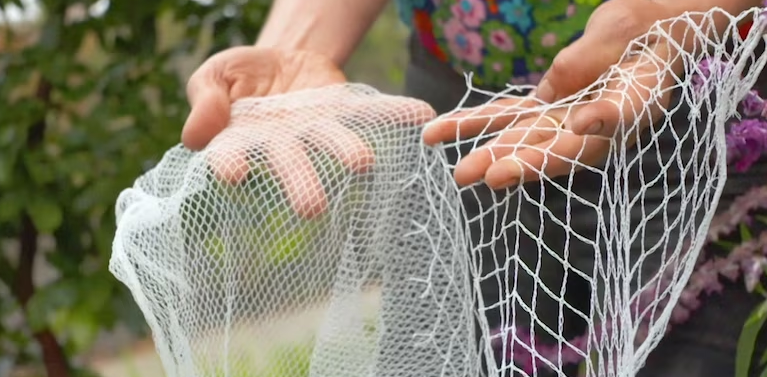
For higher-end stadium projects, knotless netting has become the preferred option. Instead of tying intersections, knotless systems are woven or braided on specialized equipment so the fibers interlock without forming bulky nodes. The result is a smoother, flatter, and more uniform net profile. From the fan’s perspective, that translates into better transparency and a cleaner visual field. The grid pattern feels softer and less intrusive, allowing the net to blend into the background more naturally.

Structurally, knotless construction can also help distribute impact loads more evenly across the net. Although it is more complex to manufacture, the improvement in optical clarity and overall finish makes it the stronger choice when fan experience is a top design priority.
Tailoring the Solution: Customization in Mesh Size and Dimensions
There is no universal netting template for a Major League Baseball stadium. Every ballpark has its own geometry, whether that involves the curvature of the seating bowl, roof height, scoreboard placement, suite layout, or field-level architecture. Because of that, the netting system needs to be custom specified for the venue rather than adapted from a standard package.

Baseball Barrier Nets
Our Baseball Barrier Nets provide a durable and safe solution for your field. Made from high-quality polyester or PP with a knotless design, they effectively contain balls and protect surroundings. Choose from white or black to enhance visibility and field aesthetics, ensuring long-lasting performance for 2-5 years outdoors.
The specification process should define the exact dimensions of each panel required to cover the risk zones identified earlier. In some cases, these panels can span hundreds of feet in length and exceed one hundred feet in height. Mesh size is another key variable. For baseball applications, the common standard is a 1-3/4 inch (44mm) square mesh. That opening is small enough to stop a baseball, which measures roughly 2.9 inches in diameter, while still keeping the net open enough to avoid a wall-like effect.
In certain locations—such as camera wells or scout seating—slightly larger mesh sizes may be considered if unobstructed viewing is especially important, provided the material is strong enough to control impact deflection. Customization also includes finishing details. Edge reinforcement, border ropes or webbing, and attachment points all need to be engineered to work with the rigging system. In some areas, breakaway sections may be added so the net can respond safely if a player collides with it. At this level, every part of the net—from fiber choice to panel sizing to edge construction—has to be specified with the same level of care used in architectural planning. That is what allows the finished system to function as a seamless extension of the stadium rather than as an afterthought.
Step 3: Precision Engineering and Installation Logistics
Once the materials are selected and the system is fully specified, the project moves from design into execution. This is the stage where engineering discipline and project logistics matter most. Installing a large-scale, high-tension netting system inside a major stadium is not a routine construction task. It requires careful coordination, specialized equipment, and a team that understands both structural demands and the realities of working in a live sports facility.
The finished system has to do several things at once: remain structurally reliable under impact and wind load, maintain proper tension, minimize sag, and fit cleanly into the visual language of the stadium. Achieving that outcome depends on translating drawings and models precisely into on-site installation. Any weakness in calculation, hardware quality, or sequencing can affect both safety and appearance, so this phase leaves very little room for error.
The Role of Digital Modeling and Cable Tension Analysis
Before installation begins, the netting system is typically modeled in a digital environment. Using CAD tools and structural analysis software, engineers create a three-dimensional representation of the stadium and overlay the proposed netting system, support structure, and anchor points. This gives the team a way to test the design in detail before any physical work begins.
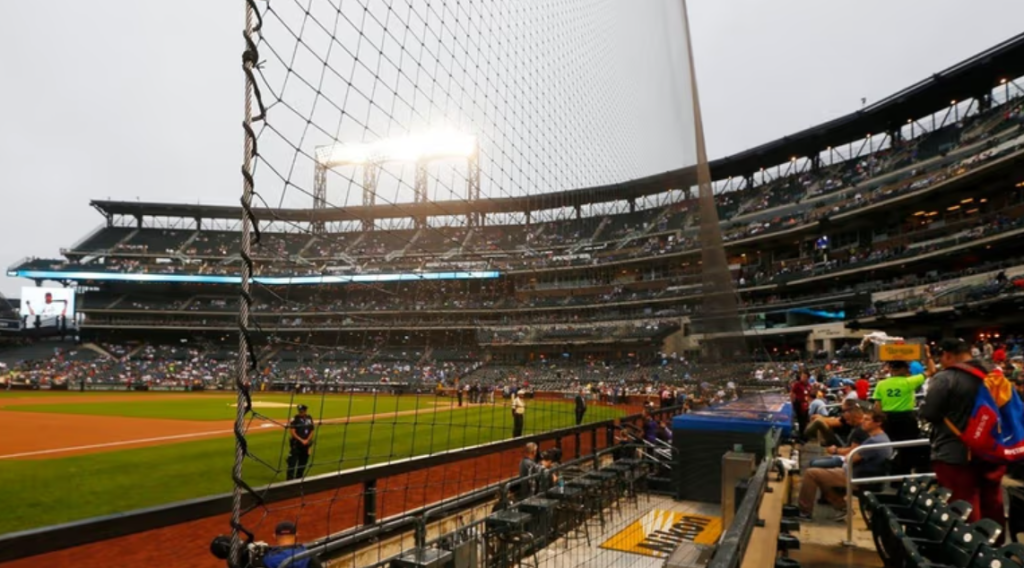
One of the most important parts of this process is cable tension analysis. The netting is usually supported by high-strength steel cables, and those cables need to be tensioned accurately. If tension is too low, the net may sag, appear unprofessional, and deflect too far under impact. If it is too high, the load transferred into the stadium structure may become excessive. Modeling software allows engineers to calculate the correct tension levels for each cable so the net profile remains controlled without overstressing the anchor points. The same digital model is also used to simulate wind loading. Because a large net behaves like a sail, strong gusts can generate substantial force across the system. By testing those conditions in advance, engineers can refine the design of poles, anchors, and hardware before installation begins. In practical terms, this digital-first approach reduces risk and helps prevent expensive on-site corrections.
Hardware and Rigging: The Unsung Heroes of a Netting System
Netting material usually gets most of the attention, but the overall system is only as reliable as the hardware supporting it. Cables, turnbuckles, clamps, shackles, anchor points, and connection rings all carry continuous loads and absorb shock during impact events. If any one of those components underperforms, the safety of the entire system is compromised.

For stadium applications, high-grade stainless steel—most commonly Type 316—is typically the preferred choice. Its corrosion resistance is especially important in outdoor environments where moisture, pollution, and, in some cases, salt exposure can affect long-term performance. In other words, choosing corrosion-resistant hardware is not a premium add-on; it is a baseline requirement for durability and safety. Every component, from the main support cables down to the smallest attachment fitting, needs to be rated to meet or exceed expected loads with an appropriate safety factor. That is also why selecting a provider for a complete baseball backstop netting system should involve more than reviewing the net itself. Hardware quality, sourcing standards, and manufacturing consistency deserve the same level of scrutiny.
The Installation Process: A Symphony of Cranes, Lifts, and Expert Riggers
The physical installation process is a complex operation and is usually scheduled during the off-season, when the venue is easier to access and project timelines can be managed with fewer disruptions. The work is typically carried out by certified riggers with experience in high-elevation installation and tensioned cable systems.
The sequence often starts with support poles and anchor points, which may require integration into the stadium’s existing concrete or steel structure. Once those major supports are in place, the main cables are lifted and set using cranes, lifts, and aerial work platforms. The net panels—custom fabricated and often packed in a specific unfolding order—are then hoisted into position and attached around the perimeter. From there, the most sensitive part of the job begins: tensioning.
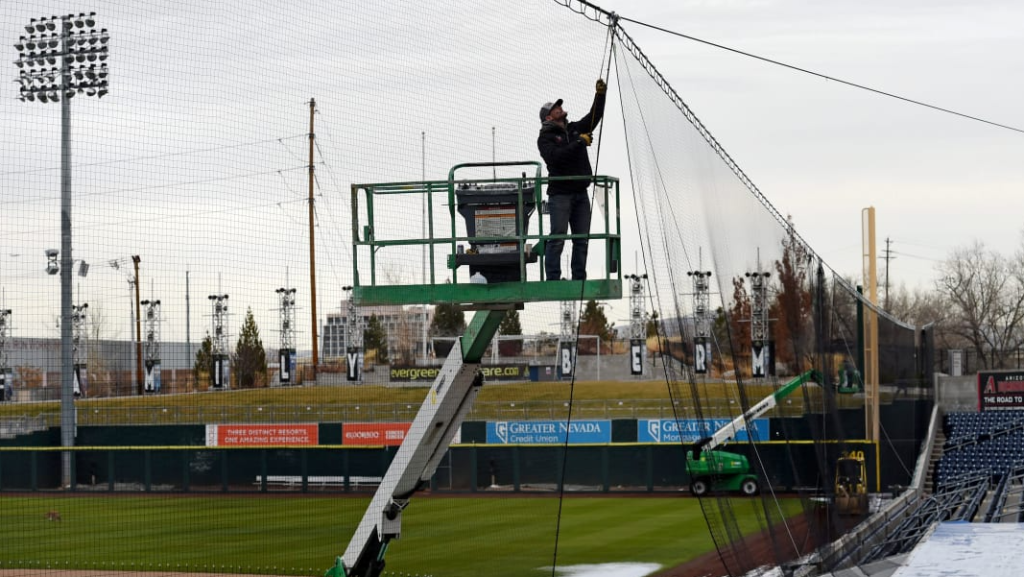
Tension is applied gradually and according to a predetermined engineering sequence, often using hydraulic equipment or specialized turnbuckles while the team monitors actual loads with measuring devices such as dynamometers. This stage cannot be rushed. As the cables are brought up to specification, the net gradually transitions from a loose suspended fabric into a taut, stable protective barrier. When done correctly, the finished result is both functional and visually disciplined, with minimal sag and clean alignment throughout the seating bowl. It is a demanding process that depends on planning, coordination, and technical skill at every stage.
Post-Installation Inspection and Long-Term Maintenance Protocols
Installation is not the end of the project. It is the beginning of the system’s service life. Any stadium netting system designed to protect spectators over the long term needs an inspection and maintenance program that is clear, routine, and documented.
Immediately after installation, the lead engineer and facility manager should complete a full walkthrough of the system. That includes checking cable tension, reviewing anchor points and hardware, and inspecting the net itself for defects or irregularities. This final verification step ensures that the installation matches the design intent and gives the venue a solid baseline record for future maintenance.

After handover, stadium staff should carry out regular visual checks to identify obvious damage from impacts, weather exposure, or debris. In addition, more detailed inspections by qualified rigging professionals should be scheduled at least once a year. These inspections typically include rechecking cable tension, examining metal components for fatigue or corrosion, and inspecting the mesh closely for cuts, abrasion, or UV-related wear. A maintenance log should be kept to document findings, repairs, and any replacement work. That record matters because it turns the system from a one-time capital project into a managed safety asset. In practical terms, long-term protection depends not only on good design and installation, but also on the discipline to maintain the system properly year after year.
Frequently Asked Questions (FAQ)
Does extended netting really ruin the fan experience?
Some fans were initially skeptical, but modern ultra-thin UHMWPE netting has addressed many of the concerns traditionally associated with extended coverage. Because the material is black, knotless, and designed for high transparency, many spectators stop noticing it after a short time. In stadiums that have adopted broader netting coverage, general feedback has been that fans appreciate the added safety and do not feel that their overall viewing experience has been meaningfully diminished.
How strong is the netting used in MLB stadiums?
The netting used in these applications is extremely strong. A single UHMWPE twine such as Dyneema®, even at a diameter of only 1.2mm to 1.8mm, can deliver a breaking strength of several hundred pounds. Once that material is engineered into a full netting system, it is capable of absorbing and distributing the force of a 110+ mph baseball or a broken bat without failure, creating a highly reliable protective barrier.
Why is the netting usually black?
Black offers the best visual performance. Because black twine absorbs light rather than reflecting it, the eye can look through the net more easily and stay focused on the field. That makes the net far less distracting in actual use. Lighter colors reflect more light and make the net pattern easier to notice, which is why they are generally less suitable for spectator-facing stadium installations.
How often does stadium netting need to be replaced?
The replacement cycle depends on the material used and the environment it is exposed to. High-quality UHMWPE netting performs well against moisture and UV exposure and can remain in service for 10 years or more when supported by proper inspection and maintenance. In many cases, replacement happens not because the net has simply worn out, but because of localized damage or because the venue chooses to upgrade to a newer system.
What is the cost associated with a full stadium netting project?
Project cost varies widely depending on the size of the venue, the total coverage area, the selected material, and local labor conditions. A full netting project for a Major League Baseball stadium can range from several hundred thousand dollars to well over one million dollars when design, engineering, materials, and installation are all included.
Can fans still get baseballs with the new netting?
Yes, although the experience is different from before. The netting stops high-velocity foul balls from entering the stands, but it does not eliminate fan interaction altogether. Players can still toss balls over or through the net between innings, and balls that hit the net often drop into accessible areas where staff can safely retrieve them and pass them to fans—especially children—in a more controlled way.
Securing a Major League Baseball stadium is not simply a matter of adding netting. It is a responsibility-driven process that combines science, engineering, and a clear understanding of how fans experience the game. It starts with a serious analysis of risk, using physics and stadium-specific data to identify where danger is most likely to arise. It continues with a careful review of materials and system design, with the goal of creating a barrier that is both highly protective and minimally intrusive. And it ends with disciplined engineering and installation, where digital modeling, hardware selection, and skilled rigging all have to come together with precision.

What ties every phase together is the same dual objective: improving safety without eroding the immediacy and enjoyment that make live baseball special. From the earliest assessment to the final cable adjustment, the best projects are the ones that protect spectators while preserving the connection between the crowd and the field. In that sense, a well-designed stadium netting system is more than a safety upgrade. It is a long-term commitment to making the game safer without losing what draws people to the stadium in the first place.

Read our most popular articles.
👉 Download our free product categories
👉 A 5-Point Buyer’s Guide to The True Cost of Sourcing: Beyond the Price Tag
👉 A 5-Point Expert Checklist: Knotted vs. Knotless Netting: Which is Right for Your Application?
👉 A 5-Step Expert Guide: “Made to Order”: A Look at Our Custom Netting Process
👉 Manufacturing vs. Local Suppliers: A Netting Buyer’s Guide — 7 Data-Backed Factors
👉 Data-Backed Case Study: Custom-Colored Netting for a Major League Stadium & Its 3 Key Wins
👉 The Chinese Manufacturing vs. Local Suppliers: A Netting Buyer