
The term “heavy-duty” is ubiquitously applied in marketing materials for industrial and commercial netting, yet it lacks a standardized, quantitative definition.
This ambiguity presents a significant challenge for professionals in sectors such as construction, logistics, and agriculture, who require specific performance characteristics for safety and operational efficiency. This analysis proposes a data-driven approach to deconstruct the “heavy-duty” label, moving beyond subjective claims to a framework based on measurable metrics. It examines five core performance indicators: tensile strength, material composition, environmental resistance, construction configuration, and certified performance standards. By evaluating netting through the lens of material science, mechanical testing protocols like those from ASTM, and regulatory compliance (e.g., ANSI/ASSP), a clearer, more functional understanding of what constitutes a robust and reliable product emerges.
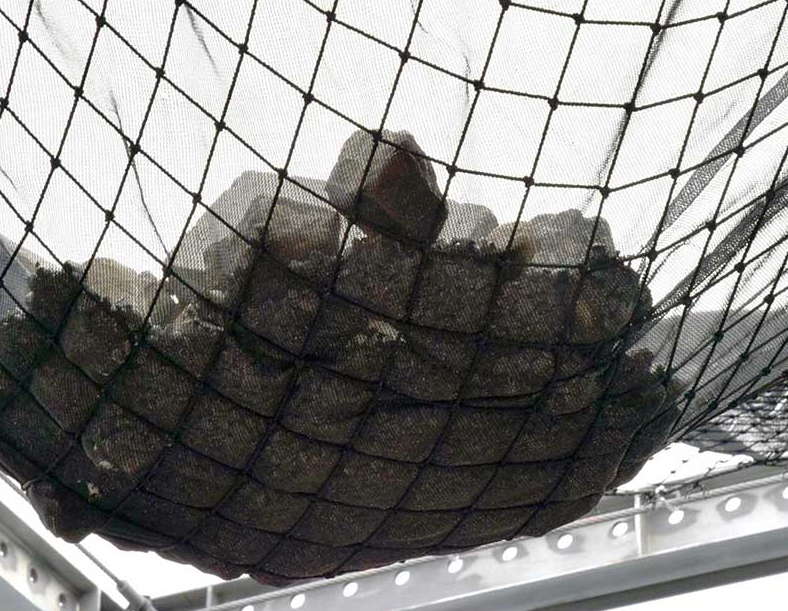
This objective methodology empowers specifiers and purchasers to select netting solutions that are not just labeled as strong, but are demonstrably fit for their intended purpose, ensuring both safety and long-term value.
الوجبات الرئيسية
- Look beyond labels; a data-driven approach is best for evaluating netting.
- Tensile strength is the primary metric for a net’s load-bearing capacity.
- Material science dictates a net’s resistance to UV rays, chemicals, and abrasion.
- Net construction, including mesh size and knot type, impacts performance.
- Official certifications (ANSI, OSHA) provide objective proof of quality.
- Understanding these metrics is key to specifying the right heavy-duty product.
Deconstructing the “Heavy-Duty” Label: A Call for Clarity
How often have you encountered a product, perhaps a tool, a piece of equipment, or in our specific context, a roll of netting, emblazoned with the words “heavy-duty”?
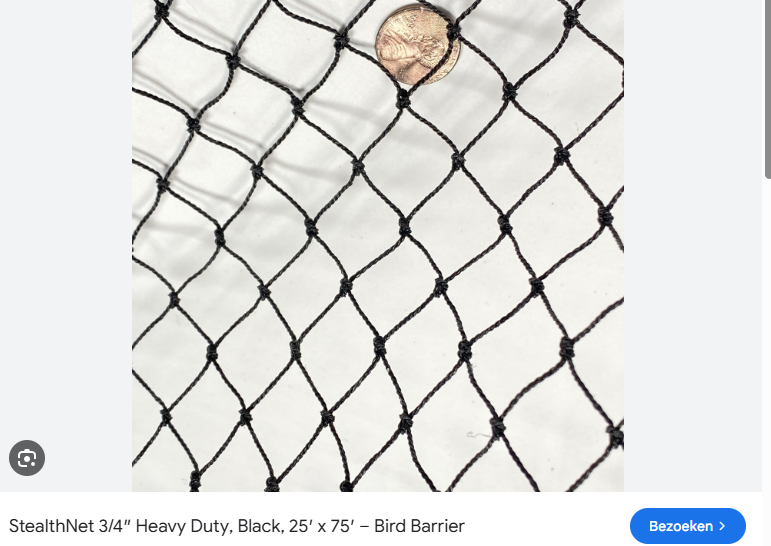
The phrase is meant to inspire confidence, to suggest a capacity for endurance and strength that transcends the ordinary. Yet, what does it truly signify? The term exists in a peculiar limbo, rich in marketing appeal but impoverished in technical specificity. It is a promise without a contract, an assertion without evidence. For a professional overseeing a construction site, securing valuable cargo, or designing a sports facility, this ambiguity is not merely an inconvenience; it represents a potential risk. The failure of a net is never a trivial matter. It can lead to property damage, project delays, regulatory fines, or, in the most severe cases, grave personal injury.
Metric 1: Tensile Strength – The Unyielding Backbone of Performance
At the very heart of a net’s capacity to perform its function—be it catching a falling object, containing debris, or stopping a speeding projectile—lies a fundamental physical property: tensile strength.
It is, perhaps, the most direct and uncompromising measure of a material’s ability to resist being pulled apart. To grasp what “heavy-duty” really means, we must first and foremost understand the language of force, stress, and strain.

What is Tensile Strength?
Imagine you are pulling on a single strand of twine. As you apply force, the material stretches. This internal resistance to the pulling force, distributed over the cross-sectional area of the twine, is known as tensile stress. The amount it stretches relative to its original length is called strain. For a time, if you release the force, the twine might return to its original length; this is its elastic region. If you continue to pull, however, you will reach a point where the stretching becomes permanent. This is the yield point. Pull even harder, and the twine will eventually snap. The maximum stress the material could withstand just before it broke is its ultimate tensile strength, or breaking strength.
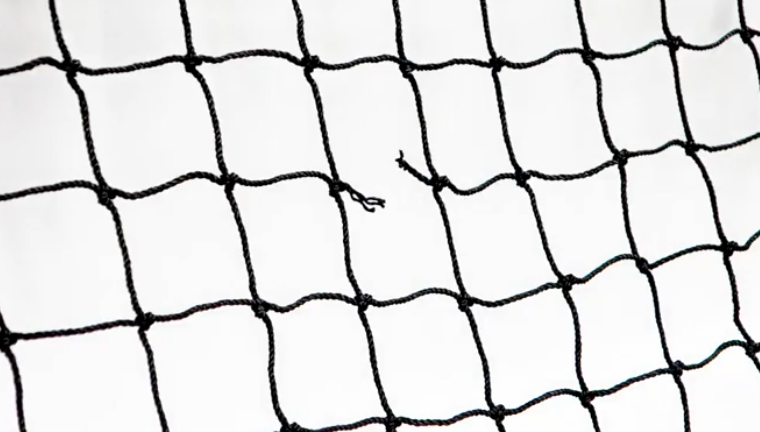
This value, typically measured in pounds-force (lbf) or Newtons (N), is the foundational number in our data-driven approach. It is not an opinion or a marketing claim; it is a result derived from a standardized, repeatable test. A higher tensile strength indicates a greater capacity to handle force without failing. When a manufacturer provides a specification sheet, the tensile strength of the twine or rope used in the net is one of the most vital pieces of data you will find.
How is it Measured?
The process of determining tensile strength is not arbitrary. It is governed by rigorous standards developed by organizations like ASTM International. A common standard for testing plastics, which includes many synthetic fibers used in netting, is ASTM D638.
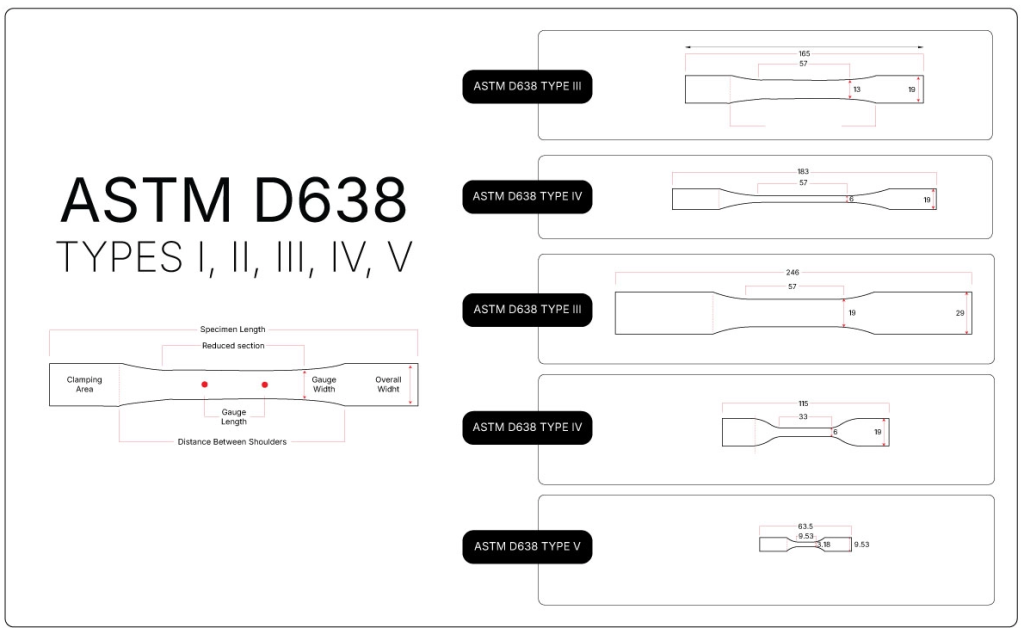
In a typical test, a sample of the material with a defined shape and size is clamped into a machine called a tensiometer. The machine then pulls the sample at a constant speed, precisely measuring the force applied and the elongation of the material until it fractures.
The data from this test produces a stress-strain curve, a graphical representation of the material’s behavior under tension. This graph reveals not just the ultimate breaking strength, but also its elasticity and ductility. For a professional, knowing that a net’s material has been tested according to a recognized standard like ASTM provides a layer of assurance. It means the stated strength is not a guess but a verified property, comparable across different products and suppliers.
Practical Implications for Netting
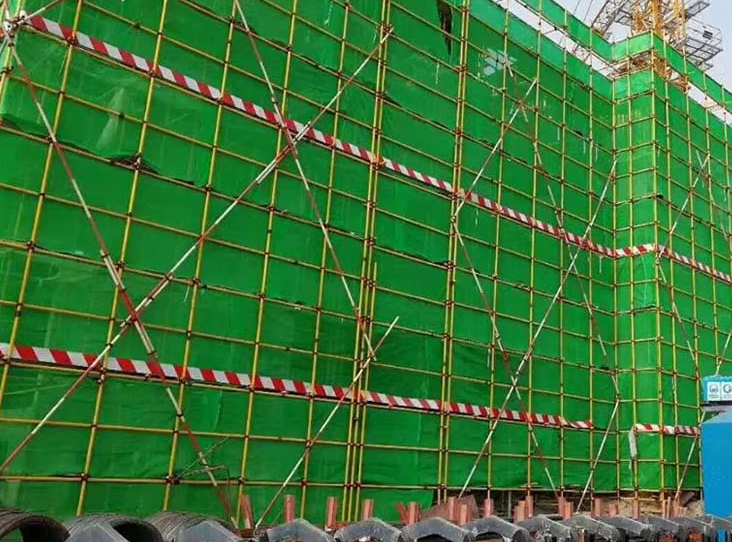
The required tensile strength is entirely dependent on the application. A net designed for bird control over a vineyard will have vastly different strength requirements from a personnel safety net on a high-rise construction project. The latter must be capable of absorbing the immense dynamic energy of a falling worker, a scenario governed by strict regulations from bodies like the Occupational Safety and Health Administration (OSHA) in the United States.

OSHA standard 1926.502(c)(4)(i), for instance, specifies that safety nets must have a minimum breaking strength of 5,000 pounds for the mesh rope. This is a non-negotiable performance threshold. In contrast, a simple debris net might only require a twine strength of a few hundred pounds. The term “heavy-duty,” therefore, is relative.
A 300-pound test net could be considered heavy-duty for containing light debris but would be catastrophically inadequate for fall protection. The data-driven approach demands that we match the verified tensile strength to the specific risks and forces of the application.

| Application Category | Typical Forces Involved | Minimum Recommended Tensile Strength (Twine) | Governing Standard Example |
|---|---|---|---|
| شبكات سلامة الأفراد | High-impact, dynamic loads (falling worker) | 5,000 lbf (22.2 kN) | OSHA 1926.502 / ANSI A10.11 |
| Heavy Debris Containment | Moderate static and dynamic loads (tools, materials) | 800 – 2,000 lbf (3.5 – 8.9 kN) | Manufacturer Specification / Local Ordinances |
| Cargo & Truck Netting | High static tension, shock loads | 1,000 – 5,000 lbf (4.4 – 22.2 kN) | DOT Regulations / WSTDA-T-1 |
| Professional Sports Barriers | High-velocity, repeated impacts (baseball, golf ball) | 400 – 1,200 lbf (1.8 – 5.3 kN) | Sport-specific best practices |
| Light-Duty Barrier/Debris | Low static loads (light debris, visual barrier) | 150 – 400 lbf (0.7 – 1.8 kN) | Manufacturer Specification |
Beyond the Number: Knot Strength vs. Straight Tensile Strength
An important subtlety in understanding tensile strength is the difference between the strength of a straight, uninterrupted piece of twine and the strength of that same twine when tied into a knot. Every knot, no matter how well-tied, reduces the tensile strength of the rope. This reduction can be significant, sometimes as much as 50% or more. This happens because the knot creates tight bends and points of high stress concentration within the fibers.
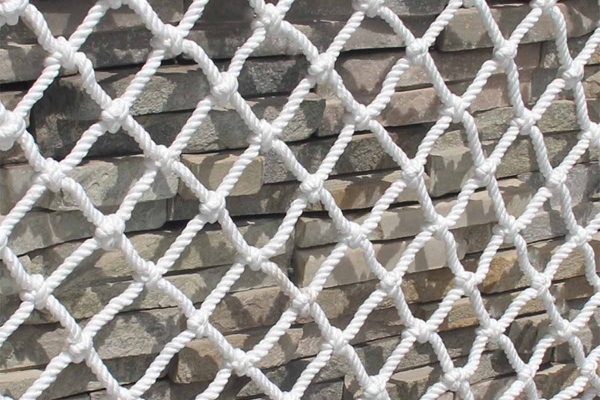
For knotted netting, the strength of the finished product is not just the strength of the twine but the strength of the system, including the knots. Reputable manufacturers test not only the raw material but also the final, knotted mesh. This “knot breaking strength” is a more realistic indicator of the net’s performance in the field. When evaluating what “heavy-duty” really means for a knotted net, it is this system strength that truly matters. Knotless netting, which is woven or knitted, avoids this issue, and its mesh strength is typically closer to the intrinsic strength of the yarn, a point we will explore further.
Metric 2: Material Science – The Intrinsic Character of a Net
If tensile strength is the headline number, material science is the detailed story behind it. The choice of polymer from which a net’s fibers are extruded is arguably the most significant factor determining its overall performance profile. Two nets can have identical dimensions and twine diameter, yet behave in profoundly different ways based on their core chemistry. A true understanding of what “heavy-duty” really means requires a working knowledge of these materials, their inherent virtues, and their predestined weaknesses. It is a journey into the molecular structure that dictates durability.
Common Synthetic Fibers: A Comparative Analysis
The world of industrial netting is dominated by a few key synthetic polymers. Each offers a distinct balance of strength, cost, and environmental resistance.
- Polypropylene (PP): This is often the workhorse material for general-purpose and light-duty applications. It is lightweight, it floats on water, and it exhibits excellent resistance to most acids and alkalis, making it suitable for certain chemical environments. However, its primary drawbacks are a relatively low tensile strength compared to other synthetics and, crucially, very poor resistance to UV radiation unless specifically treated. An untreated polypropylene net exposed to direct sunlight will become brittle and fail in a surprisingly short time.
- Polyethylene (PE): Sharing some characteristics with polypropylene, polyethylene is also lightweight and waterproof. It tends to be slightly more durable and abrasion-resistant. High-Density Polyethylene (HDPE) is a common choice for applications like agriculture and aquaculture netting, where its resistance to moisture and low cost are advantageous. Like polypropylene, its UV stability is a concern that must be addressed with additives.
- Nylon (Polyamide, PA): Here we enter the realm of what many consider to be genuinely heavy-duty materials. Nylon boasts a superior tensile strength-to-weight ratio compared to the polyolefins (PP and PE). Its most distinctive characteristic is its elasticity and ability to absorb shock loads. When a sudden force is applied, a nylon rope or net will stretch, absorbing a great deal of energy before reaching its breaking point. This makes it an ideal candidate for applications like personnel safety nets and climbing ropes. Its primary vulnerability is its performance when wet. Nylon absorbs water, which can lead to a temporary loss of strength (around 10-15%) and an increase in elongation.
- Polyester (PET): If nylon is the shock absorber, polyester is the steady workhorse for outdoor applications. It is nearly as strong as nylon but has one critical advantage: it exhibits very low stretch and does not lose strength when wet. Furthermore, it possesses inherently better resistance to UV radiation and abrasion than nylon. This combination of properties makes polyester the premier choice for applications requiring long-term dimensional stability in exposed environments, such as stadium backstops, cargo nets, and permanent perimeter fencing.
High-Performance Fibers: The Elite Class
Beyond the common synthetics lies a category of materials engineered for the most extreme demands. These are the materials you find when “heavy-duty” is not just a goal, but a life-or-death requirement.

- Dyneema® / HMPE (High-Modulus Polyethylene): This is not your everyday polyethylene. Through a specialized gel-spinning process, the polymer chains are aligned to an extraordinary degree, creating a fiber that, pound for pound, is up to 15 times stronger than steel. HMPE is exceptionally lightweight (it floats), has near-zero stretch, and demonstrates outstanding resistance to abrasion and chemicals. Its use in حلول المعاوضة المخصصة has revolutionized applications from aquaculture cages that must withstand predator attacks to ultra-lightweight safety nets for motorsports. The primary tradeoff is its higher cost and a lower melting point compared to other fibers.
- Kevlar® / Aramid: Best known for its use in ballistic vests, Aramid fiber’s defining characteristic is its incredible strength and heat resistance. It does not melt; it decomposes at a very high temperature (around 500°C or 932°F). It has excellent tensile strength and low stretch. However, aramid is susceptible to degradation from UV exposure and does not handle shock loading as well as nylon. Its strength is best utilized in static tension. For netting, it is a specialty material used where extreme heat or cut resistance is the primary concern.
Material Selection in Context
The choice of material is not about finding the “best” one, but the right one. A data-driven approach means mapping the material’s properties to the application’s environment and demands. Is the net for indoor or outdoor use? Will it be exposed to sunlight, chemicals, or moisture? Is the primary load static or dynamic? Answering these questions allows you to make an informed decision, moving beyond a generic “heavy-duty” label to a specific material choice.
| Fiber Type | قوة الشد | مقاومة الأشعة فوق البنفسجية | مقاومة التآكل | Stretch/Elongation | امتصاص الماء | التكلفة |
|---|---|---|---|---|---|---|
| البولي بروبلين (PP) | منخفضة | Poor (unless treated) | Fair | متوسط | منخفضة جداً | منخفضة |
| Polyester (PET) | عالية | ممتاز | جيد جداً | منخفضة | منخفضة جداً | متوسط |
| Nylon (PA) | عالية جداً | جيد | ممتاز | High (Shock Absorbing) | High (loses strength) | متوسط |
| HMPE (e.g., Dyneema®) | Exceptional | ممتاز | Exceptional | منخفضة جداً | None (floats) | عالية جداً |
| Aramid (e.g., Kevlar®) | Exceptional | Poor | جيد | منخفضة جداً | عالية | عالية جداً |
As the table illustrates, a polyester net is a far more “heavy-duty” choice for a permanent outdoor installation than an untreated polypropylene one, even if their initial tensile strengths were similar. The polypropylene net would fail due to environmental factors, a failure mode our data-driven approach accounts for.
Metric 3: Environmental Resistance – The Endurance Trial Against Nature
A net’s life is often a constant battle against the elements. A truly “heavy-duty” product is not just one that is strong on day one, but one that retains its strength after months or years of exposure to sunlight, rain, chemicals, and physical wear. Evaluating this endurance requires looking at a set of properties that are distinct from, but just as important as, raw tensile strength. This is the metric of resilience.
UV Degradation: The Silent Killer of Polymers
Of all the environmental challenges a net faces, none is more pervasive or destructive than ultraviolet (UV) radiation from the sun. UV rays trigger a process called photodegradation. In essence, the high-energy photons break the long polymer chains that give the fibers their strength. The material becomes brittle, loses its elasticity, and its tensile strength plummets.
This is not a theoretical concern; it is the primary reason why outdoor nets fail over time.

A data-driven approach to what “heavy-duty” really means in this context involves looking for specific information on UV resistance.
- Inherent Material Properties: As we discussed, materials like polyester and HMPE have inherently better UV resistance than polypropylene or even nylon (Heddan, 2015). Choosing the right base material is the first line of defense.
- UV Inhibitors: Manufacturers can mix chemical stabilizers into the polymer resin before it is extruded into fiber. These additives work by absorbing or reflecting the UV radiation, protecting the polymer chains. A specification sheet that simply says “UV treated” is a start, but better documentation will specify the type and amount of inhibitor used.
- Performance Testing: The gold standard is data from accelerated weathering tests. Machines are used to expose material samples to intense UV light, temperature cycles, and moisture to simulate years of outdoor exposure in a matter of weeks or months. The results are often expressed in terms of kilolangleys (kLy), a unit of solar radiation, or as a percentage of strength retained after a certain number of hours of exposure (e.g., “retains 50% of original strength after 1000 hours in a Xenon Arc Weather-Ometer”). This is hard data that replaces guesswork about a net’s lifespan.
Chemical and Moisture Resistance
In many industrial, agricultural, and marine environments, netting is exposed to a wide range of chemicals. This could be anything from pesticides and fertilizers in a field, to cleaning solvents in a factory, to the saltwater of the ocean. The material’s ability to withstand these substances without degrading is a key component of its durability.
Polyolefins (polypropylene and polyethylene) are chemical superstars in this regard, showing excellent resistance to a wide range of acids, bases, and solvents. This is why they are often used for containers and liners. Polyester is also very good, with resistance to most acids and oxidizing agents. Nylon, on the other hand, is more vulnerable. It can be weakened by strong acids and bleaching agents.
Moisture is another critical factor. As previously noted, nylon’s tendency to absorb water and lose strength makes it a less-than-ideal choice for applications where it will be permanently wet. Polyester and the polyolefins, with their hydrophobic nature, are far superior in marine or perpetually damp conditions. A “heavy-duty” marine net is almost certain to be made of polyester or HMPE, not nylon.
Abrasion Resistance: The Test of Physical Contact
Abrasion is the damage caused by rubbing and friction. It can occur when a net rubs against a rough surface, when cargo shifts against a truck net, or when debris scrapes down the face of a containment system. This wear can slowly sever the outer fibers of a twine, gradually reducing its diameter and its strength.
A material’s resistance to abrasion is related to its hardness and the smoothness of its fibers. Nylon, with its smooth, tough molecular structure, generally offers excellent abrasion resistance. HMPE is even better, with a very low coefficient of friction that allows it to slide over surfaces with minimal damage. Polyester also performs very well. Polypropylene, being a softer material, is typically the most susceptible to this type of wear.
In applications with high abrasion risk, such as lifting slings or nets that will be dragged, coatings can be applied. A coating of urethane, for example, can act as a sacrificial layer, protecting the structural fibers beneath. When evaluating a net for an abrasive environment, the presence and type of such a coating is a key data point in assessing its “heavy-duty” credentials.
Metric 4: Construction and Configuration – The Architectural Logic of a Net
A pile of high-strength twine is not a net. The process of transforming that raw material into a functional structure is a matter of engineering and geometry. The way a net is constructed—its mesh size, twine diameter, and the method used to join the twines—has a profound impact on its performance. To truly understand what “heavy-duty” really means, we must appreciate the architectural choices that define the final product.
Mesh Size and Twine Diameter: The Geometric Factors

These two parameters are the most basic elements of a net’s design.
- قطر البرمة: This is simply the thickness of the rope or twine used to make the net. It is usually measured in millimeters (mm) or inches. All else being equal, a thicker twine will be stronger than a thinner one of the same material. However, it will also be heavier, more expensive, and create more wind resistance. Doubling the diameter of a twine does not double its strength; it increases it by a factor of four (since strength is related to the cross-sectional area, which is proportional to the square of the radius). This is a crucial concept. A small increase in diameter can lead to a large increase in strength and weight.
- حجم الشبكة: This refers to the size of the openings in the net. It is typically measured “on the square” (the distance from the center of one knot to the center of the next, along one side of the square) or “on the stretch” (the distance between two opposite knots in a single mesh when it is pulled taut). The choice of mesh size is a functional one. For a baseball backstop net, the mesh must be small enough to stop a baseball (e.g., 1.75 inches). For a construction debris net, the mesh size is dictated by the size of the materials it is intended to catch. A smaller mesh size means more material is used per square foot of netting, which increases the weight, cost, and wind load, but also distributes impact forces over more junctions.
A “heavy-duty” net for containing small debris will have a very different geometry (small mesh, perhaps moderate twine) from a “heavy-duty” net for stopping large, heavy objects (large mesh, very thick twine). The term is meaningless without the context of these geometric data points.
Knotted vs. Knotless Netting: A Functional Divide
The junctions where the horizontal and vertical twines meet are critical points in a net’s structure. There are two primary methods for creating these junctions:
- Knotted Netting: This is the traditional method, where twines are intersected and secured with a knot, often a “sheet bend” or a similar stable knot. The primary advantage of knotted netting is its dimensional stability. The knots lock the mesh squares in place, preventing them from distorting or stretching under load. This makes it ideal for applications where a consistent opening size is important, such as in fishing or certain types of sports netting. As discussed earlier, the main disadvantage is the reduction in strength caused by the knot itself. The knot also creates a more abrasive, high-profile surface, which can be a negative in applications where the net might come into contact with sensitive surfaces or people.
- Knotless Netting: This type of netting is manufactured through a weaving or knitting process that joins the twines without tying them. The result is a smoother, lighter product with a consistent strength that is not compromised by knots. Because it is flatter and less abrasive, it is often preferred for applications like playground netting, soft-toss nets in baseball, or anywhere the net might have direct contact with people. Knotless nets can sometimes have a higher initial stretch as the weave settles under load, but high-quality versions are “pre-stretched” or “heat-set” to minimize this. For many modern applications, a high-performance knotless net made from a material like HMPE represents the pinnacle of “heavy-duty” design, combining low weight with incredible strength.
Coatings and Treatments: Enhancing Performance
The final step in a net’s construction is often the application of a post-treatment or coating.
These are not afterthoughts; they are integral parts of the design that can dramatically improve a net’s durability and functionality.

- Urethane/Latex Coatings: These are often applied by dipping the entire net. The coating bonds the fibers of the twine together, increasing abrasion resistance. It also helps to lock the knots in place in knotted netting, preventing them from slipping. A black latex or urethane dip is also a very effective way to add UV protection.
- Fire Retardants: For indoor applications in public venues, or in certain industrial settings, netting must meet fire codes. This is achieved by treating the net with a fire-retardant chemical. A specification sheet for such a net should reference a specific fire safety standard, such as NFPA 701.
- Color: While it may seem purely aesthetic, color can be a functional attribute. Black is the most common color for outdoor netting because the carbon black pigment used is an excellent and inexpensive UV blocker. For other applications, high-visibility colors like orange or yellow might be used for safety barriers.
A truly comprehensive, data-driven assessment of a net must include these construction details. A thick, knotted nylon net might seem “heavy-duty,” but if it is untreated and intended for an abrasive, outdoor environment, a lighter-gauge, urethane-coated, knotless polyester net could be the far more durable and appropriate choice.
Metric 5: Certified Performance – The Objective Verdict of Quality
In the preceding sections, we have built a framework for analysis based on material properties and construction methods. This final metric moves from the theoretical to the proven. Certified performance is about third-party validation.
It is the evidence that a product not only claims to have certain properties but has been tested and verified to meet specific, recognized standards. For safety-critical applications, this is not just a desirable feature; it is an absolute requirement.
The Role of Standards Organizations
Several national and international bodies develop and maintain standards relevant to netting. Their work provides an objective benchmark against which products can be measured.
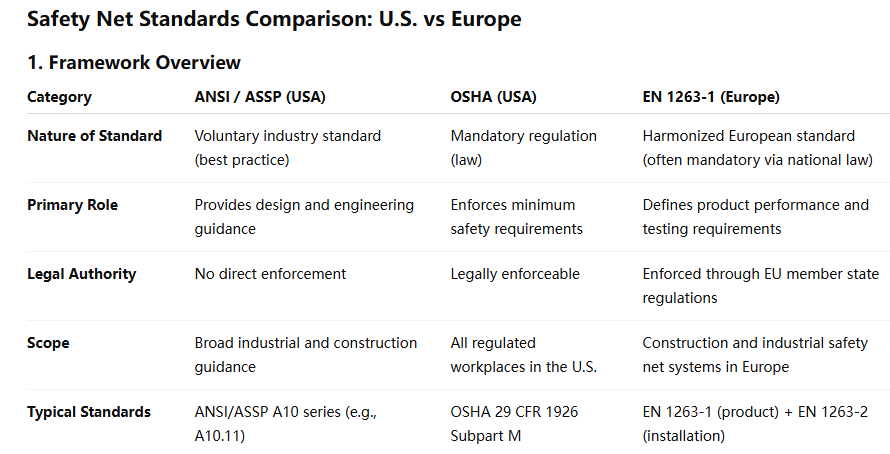
- ANSI/ASSP (American National Standards Institute / American Society of Safety Professionals): This is a key organization in the United States for safety standards. For example, the ANSI/ASSP A10.11 standard provides detailed requirements for the design, testing, and use of safety nets for construction and demolition. It specifies minimum mesh breaking strengths, test procedures for the finished nets, and guidelines for installation. Compliance with this standard is a powerful indicator of a “heavy-duty” personnel safety net.
- OSHA (Occupational Safety and Health Administration): While OSHA is a regulatory agency, not a standards-developing organization, its regulations are law in the US workplace. OSHA’s rules for fall protection, found in 29 CFR 1926 Subpart M, often incorporate or reference standards like those from ANSI. They set a legally enforceable minimum level of performance. For example, the 5,000-pound breaking strength requirement for safety net mesh is an OSHA mandate.
- EN (European Norms): In Europe, the EN standards serve a similar purpose. For instance, EN 1263-1 specifies the safety requirements and test methods for safety nets used in construction. A net sold in Europe that is certified to EN 1263-1 has undergone rigorous testing, including a test for energy absorption and a UV degradation test where a sample is aged and then tested for residual strength.
When a manufacturer states that their netting “meets” or is “certified to” one of these standards, it implies that they have the test data to back it up.
A discerning buyer should not hesitate to ask for this documentation.
Reading a Specification Sheet: A Guided Tour
A detailed specification sheet is the summation of a data-driven approach. It is the document that translates all the metrics we have discussed into a concise format.
Let’s imagine a spec sheet for a high-quality debris net:
- Product: Knotted Debris Net
- المادة: High-Tenacity Polyester (PET)
- قطر البرمة: 3mm
- البناء: Knotted, 4-strand twisted
- حجم الشبكة: 1-inch square
- Tensile Strength (Twine): 950 lbf (ASTM D638)
- Knot Breaking Strength: 500 lbf
- Coating: Heavy Urethane Dip, Black
- UV Resistance: Retains >70% strength after 1200 hours QUV accelerated weathering test
- Fire Retardant: غير متاح
What does this tell us? It tells us the material (polyester) is excellent for outdoor use. The twine is robust (950 lbf), and the manufacturer is transparent about the strength reduction at the knot (500 lbf). The 1-inch mesh is suitable for catching small debris. The urethane coating will enhance abrasion resistance and lock the knots. Most importantly, the specific UV resistance data gives us confidence in its long-term durability. This is what a “heavy-duty” specification looks like. It is a mosaic of data, not a single adjective.
The Importance of Batch Testing and Quality Control
A final consideration is consistency. A manufacturer can produce a great prototype, but can they produce ten thousand square feet of it to the same standard? This is where quality control comes in. Reputable manufacturers implement a system of batch testing. From each large production run, they take a sample of the finished netting and test it to destruction to ensure it meets the specified strength.
This commitment to ongoing testing is a hallmark of a serious supplier. It ensures that the net delivered to your job site in June has the same performance characteristics as the one delivered in January. When human safety is on theline, this assurance is priceless. It is the final piece of the puzzle in our quest to define what “heavy-duty” really means: it means a product that is not only strong by design but is proven to be strong in practice, time and time again.
Bringing It All Together: A Case Study Approach
Theory is valuable, but its true power is revealed in application. Let’s walk through how to use our five-metric framework to solve real-world problems. This is the process of moving from a passive consumer to an active, informed specifier of netting solutions.
Case Study 1: Specifying a Construction Debris Net for a High-Rise Façade
The Scenario: You are the safety manager for a project involving masonry repair on the 20th floor of a building in a dense urban area.

You need a netting system to contain falling debris, from small chips of mortar to an accidentally dropped brick. The net will be exposed to the elements for at least six months.
The Thought Process:
- Tensile Strength: The primary load is debris containment, not personnel safety. However, the potential for a heavier object like a brick to fall means we need more than a light-duty net. A brick weighs about 5 pounds, but falling 20 stories, it will generate significant impact energy. We should look for a net with a mesh breaking strength of at least 500-800 lbf. This provides a substantial safety factor.
- Material Science: The net will be outdoors for six months, so UV resistance is paramount. This immediately rules out untreated polypropylene. Nylon would be strong, but its stretchiness might not be ideal for containment, and it could weaken in the rain. Polyester is the logical choice. It has excellent strength, low stretch, and superior inherent UV resistance.
- Environmental Resistance: Beyond the UV concern, the urban environment might expose the net to pollutants. Polyester’s good chemical resistance is a benefit here. We need to ensure the product has robust UV treatment. We should ask the supplier for data on strength retention after accelerated weathering, not just a vague “UV treated” claim. A black color will also help.
- Construction & Configuration: The mesh size must be small enough to contain the smallest anticipated debris, like mortar chips. A 1-inch or even smaller mesh would be appropriate. Since the net will be subject to wind load and needs to hang flat, a dimensionally stable knotted construction is a good choice. A urethane or latex coating will add abrasion resistance as the net scrapes against the building façade and will help protect the knots.
- Certified Performance: While there may not be a specific ANSI standard for this exact application, we can look for a manufacturer that provides detailed spec sheets and can verify their tensile strength claims with test reports (e.g., in accordance with ASTM methods). We also need to consider fire retardancy. If the building is occupied or local codes require it, we must specify a net treated to meet the NFPA 701 standard.
The Resulting Specification: A knotted, 1-inch mesh net, constructed from 3mm high-tenacity black polyester twine, with a minimum knot breaking strength of 600 lbf. The net must be coated with black urethane and the manufacturer must provide a certificate of compliance for NFPA 701 and test data showing >60% strength retention after 1,000 hours of accelerated UV testing.
This is a specific, enforceable, and data-driven specification. It is what “heavy-duty” means for this application.
Case Study 2: Designing a Professional Baseball Backstop
The Scenario: A university is upgrading its baseball field and needs a new backstop. The goal is maximum player and spectator safety, excellent visibility for fans, and long-term durability with minimal maintenance.

The Thought Process:
- Tensile Strength: The loads are high-velocity, repeated impacts from baseballs and bats. While the force of a single baseball is not extreme, the repeated nature of the impacts can cause fatigue. A twine breaking strength in the 350-500 lbf range is typical and sufficient, but the material’s ability to handle these repeated loads without fraying is key.
- Material Science: This is a permanent outdoor installation, so UV resistance is the number one priority. Again, this points away from polypropylene and nylon. The choice here is between polyester and HMPE (Dyneema®). Polyester is the traditional, cost-effective, and highly durable choice. HMPE is the premium option. It is significantly stronger for a given diameter, allowing for a much thinner twine. This thinner twine dramatically improves spectator visibility—a key project goal.
- Environmental Resistance: The net will see sun, rain, and wind. The UV resistance of either polyester or HMPE is excellent. Abrasion resistance is also a factor, as the net will rub against poles and cables. Both materials perform well, but an HMPE net with a urethane coating would be the top performer.
- Construction & Configuration: A baseball has a diameter of about 2.9 inches. A 1.75-inch square mesh is the industry standard to ensure no ball can pass through. To maximize visibility, we want the thinnest possible twine that still meets our strength and durability requirements. If using polyester, a 3.0mm twine might be needed. If we opt for the premium HMPE material, we could achieve the same or greater strength with a twine as thin as 1.8mm. This is a huge difference in visibility. A knotless construction is often preferred for backstops. It provides a smoother, flatter viewing plane and eliminates the bumps and abrasions of knots.
- Certified Performance: There is no single “backstop standard,” so we rely on the manufacturer’s reputation and their quality control. We would ask for specification sheets for the exact product, including data on twine breaking strength and UV testing. We would also inquire about their batch testing procedures to ensure consistency.
The Resulting Specification (Premium Option): A knotless netting with 1.75-inch square mesh, constructed from 1.8mm HMPE (Dyneema®) twine. The twine must have a minimum breaking strength of 400 lbf. The net must be black and coated with urethane for enhanced abrasion and UV protection. The manufacturer must provide test reports verifying strength and a 10-year pro-rated warranty against UV degradation.
By using the five-metric framework, we have designed a solution that is not just “heavy-duty,” but is precisely tailored to the complex demands of the application, balancing safety, performance, and even aesthetics.
الأسئلة المتداولة (FAQ)
What is the best “heavy-duty” material for outdoor use?
For most permanent outdoor applications, polyester (PET) offers the best balance of high tensile strength, excellent UV resistance, low stretch, and good abrasion resistance at a reasonable cost. For applications demanding the absolute highest strength-to-weight ratio and superior durability, High-Modulus Polyethylene (HMPE), like Dyneema®, is the premium choice.
How does knot type affect a net’s strength?
Any knot in a rope or twine creates stress concentrations that reduce its overall tensile strength, a reduction that can range from 30% to 50% or more. This is why manufacturers often provide both a “twine strength” and a lower “knot breaking strength.” Knotless netting, which is woven, avoids this issue and retains a higher percentage of the material’s intrinsic strength.
Is a thicker twine always a stronger net?
Yes, assuming the material is the same, a thicker twine will create a stronger net. However, strength increases with the square of the diameter, not linearly. A small increase in thickness adds significant strength but also significant weight, wind-load, and cost. The goal is to choose the most efficient twine diameter for the specific load requirements of the application.
How long can I expect a UV-treated net to last?
The lifespan depends on the base material, the quality of the UV inhibitors, and the intensity of the solar exposure at the installation site. A high-quality, black polyester or HMPE net can last 10 years or more. A lower-quality, UV-treated polypropylene net might only last 1-3 years in a high-sun environment. Always ask for specific data from accelerated weathering tests (e.g., hours of exposure and percentage of retained strength) rather than relying on vague assurances.
What does a fire-retardant certification like NFPA 701 mean?
NFPA 701 is a standard test method for measuring the flame propagation of textiles and films. A net certified to NFPA 701 has been tested by an independent lab and demonstrated that it will not propagate a flame after being exposed to an ignition source. It will char and self-extinguish. This is a critical safety requirement for most indoor netting used in public spaces like gymnasiums, theaters, and arenas.
Can I repair a damaged heavy-duty net?
Small holes or tears in many types of netting can be repaired. The proper method is to patch the hole with a new piece of netting that has the same or greater strength as the original. The patch should overlap the hole by several meshes and be securely laced to the original net using a high-strength repair twine, typically with a knot at every attachment point. For personnel safety nets, all repairs must be done in strict accordance with manufacturer instructions and ANSI/ASSP standards.
Why is knotless netting sometimes preferred over knotted?
Knotless netting is often preferred for several reasons. It is generally lighter and has a lower profile than knotted netting of the same strength. Its smooth surface is less abrasive, making it safer for applications involving people, like playgrounds or sports. It also offers better visibility in spectator applications because there are no bulky knots to obstruct the view. Finally, it does not have the inherent strength loss associated with knots.
Final
We have moved from the vague to the specific, replacing a single adjective with a five-part analysis of tensile strength, material science, environmental resilience, construction geometry, and certified performance. We have seen how a number on a specification sheet, like a 5,000-pound break strength, is not just a number, but a reflection of a legal and moral obligation to protect a life. We have understood that the choice between polyester and nylon is not arbitrary, but a calculated decision based on the predictable behavior of their molecular structures when faced with sunlight and water.

اقرأ مقالاتنا الأكثر شعبية.
👉 قم بتنزيل فئات منتجاتنا المجانية
👉 دليل عملي من 15 نقطة: قائمة المراجعة الكاملة لتركيب الشباك الرياضية
👉 Beyond Breaking Strength: A Comprehensive Guide to Netting ion, Safety, and Risk Management
👉 5 Reasons Why Durable, Long-Lasting Products are the New Definition of “Cost-Effective”
👉 The True Cost of Cheap Netting: A Total Cost of Ownership Analysis
👉 مثبتات الأشعة فوق البنفسجية في الشباك الرياضية: دليل شامل لطول العمر الافتراضي
👉 Beyond Breaking Strength: A Comprehensive Guide to Netting ion, Safety, and Risk Management