
This article provides a comprehensive examination of the US Department of Transportation (DOT) and Federal Motor Carrier Safety Administration (FMCSA) cargo securement regulations. It begins by elucidating the foundational principles of containment, immobilization, and restraint that underpin the legal framework.

The guide then presents a detailed five-step process for compliance, starting with an exploration of the regulatory scope, performance requirements, and the general rules outlined in 49 CFR §393. A significant portion is dedicated to the critical concept of Working Load Limit (WLL), providing clear methodologies for calculating aggregate WLL and avoiding common errors. The text evaluates the taxonomy of securement devices, from traditional chains and straps to modern solutions like specialized cargo netting. It further delves into the nuanced, commodity-specific rules for securing items such as heavy machinery, logs, metal coils, and concrete pipes. Finally, the article outlines the indispensable practice of pre-trip and en-route inspections, emphasizing driver responsibility for maintaining load integrity throughout a journey.

Key Takeaways
- Understand the three core principles: containment, immobilization, and tiedowns.
- The aggregate Working Load Limit (WLL) of tiedowns must be at least 50% of the cargo’s weight.
- Select securement devices based on the specific commodity being transported.
- Master the complete US DOT and FMCSA cargo securement regulations to ensure compliance.
- Always perform pre-trip and periodic en-route inspections of your cargo and restraints.
- Certain commodities have unique and highly specific securement requirements.
- Properly documenting inspections can be vital in demonstrating due diligence.
The Foundational Pillars: Three Core Principles of Cargo Securement
Before we immerse ourselves in the specific articles and sub-sections of federal code, it is beneficial to step back and contemplate the philosophical underpinnings of these rules. The regulations are not arbitrary obstacles; they are the codified expression of fundamental physics and a profound ethical commitment to public safety. At their heart, the US DOT and FMCSA cargo securement regulations are built upon three simple, yet powerful, pillars.

Understanding these principles provides a mental framework that makes the detailed rules intuitive rather than just a list to be memorized. Think of these as the spirit of the law, which animates the letter of the law.
Principle 1: Containment
The principle of containment addresses the cargo as a whole. It dictates that the cargo must not be allowed to leak, spill, blow, or fall from the commercial motor vehicle. This seems self-evident, yet its implications are broad. For a driver hauling gravel or sand, containment means having a properly fitted and secured tarp that prevents small particles from becoming projectiles on the highway. For a truck carrying thousands of individual boxes, containment means ensuring the entire load is unitized or enclosed in such a way that no single box can work its way free.

The cargo must remain within the confines of the vehicle’s structure—whether that structure is the walls of a van trailer, the stakes of a flatbed, or a comprehensive netting system. It is the first line of defense against loss of cargo.
Principle 2: Immobilization
Once contained, the cargo must be prevented from shifting. This is the principle of immobilization. Imagine a single, heavy crate placed in the center of a flatbed trailer. Without any restraints, the forces of acceleration, braking, and turning will cause it to slide or tip. Immobilization is achieved when the cargo is held so firmly that it essentially becomes one with the vehicle. This can be accomplished through several means. Blocking involves placing sturdy material in front of, behind, and to the sides of the cargo to prevent horizontal movement. Bracing involves using supports to prevent tipping. The cargo might also be positioned snugly against a headboard or other fixed structures on the vehicle.

The goal is to eliminate any significant gaps around the cargo, ensuring that the dynamic forces of transit are transferred through the securement system and the vehicle frame, not by the cargo shifting and gaining momentum.
Principle 3: Tiedowns and Restraint
The third principle, restraint, is perhaps the most visible aspect of cargo securement. It involves the use of devices—tiedowns—that pass over or through the cargo to affix it directly to the vehicle. These tiedowns, which can be chains, straps, wires, or even high-tensile custom cargo nets, apply downward pressure that both increases friction (helping with immobilization) and physically prevents the cargo from lifting or tipping.

The regulations are very specific about the strength and number of tiedowns required, a concept we will explore deeply through the lens of Working Load Limits (WLL).
This principle recognizes that blocking and bracing alone may not be sufficient to counteract the complex forces a vehicle experiences, especially during emergency maneuvers or on uneven road surfaces. The tiedowns are the active elements that hold everything in place against the relentless pull of physics.
The Spirit vs. The Letter of the Law
Contemplating these three principles allows a driver or a fleet manager to develop a sense of what “secure” truly means. When you look at a loaded trailer, you can ask yourself: Is it contained? Is it immobilized? Is it properly restrained by tiedowns? If you can answer yes to all three with confidence, you have likely met not just the letter of the law, but its fundamental intent. This mindset is invaluable because it promotes problem-solving.

The regulations cannot possibly foresee every unique shape and weight of cargo. But a person who understands these core principles can adapt their methods to secure even the most unusual loads safely and effectively, moving beyond mere compliance to a state of genuine professional competence and care for the well-being of others on the road.
Step 1: Grasping the Regulatory Framework
With the foundational principles established, our first practical step is to understand the legal landscape itself. The rules governing cargo securement are not a single, monolithic document but a specific part of the broader Federal Motor Carrier Safety Regulations (FMCSRs).
Navigating this requires knowing where to look and understanding the key definitions and performance standards that form the backbone of the law. This is not about memorizing code numbers but about grasping the logic and scope of the regulations that dictate daily operations for millions of drivers.
Who Must Comply? The Scope of FMCSA Rules
The first question one must ask is, “Do these rules apply to me?” The answer is found in the applicability of the FMCSRs. Generally, these regulations apply to anyone operating a Commercial Motor Vehicle (CMV) in interstate commerce.

A CMV is defined by its weight, passenger capacity, or use in transporting hazardous materials. For cargo securement purposes, the most relevant definition is a vehicle with a Gross Vehicle Weight Rating (GVWR) or Gross Combination Weight Rating (GCWR) of 10,001 pounds or more.
This means that the driver of a heavy-duty pickup truck pulling a large trailer for a landscaping business is subject to the same fundamental cargo securement rules as the driver of a Class 8 tractor-trailer.

While some specific commodity rules may not apply, the general securement performance requirements do. It is a common and costly misconception that these rules are only for “big rigs.”
Many states have also adopted the federal rules (or very similar ones) for intrastate commerce, making them nearly universal across the United States.
The General Rule: §393.102
The heart of the general cargo securement standard is found in Title 49 of the Code of Federal Regulations, Part 393, Section 102 (49 CFR §393.102). This section states that cargo must be “firmly immobilized or secured on or within a vehicle” by structures of adequate strength, dunnage, shoring bars, tiedowns, or a combination of these.

It explicitly sets out the performance requirements that all securement systems must meet. This is the baseline standard from which all other specific rules are built. It is the section a compliance officer will cite for a load of mixed freight that is not properly blocked, braced, and tied down.
Performance Requirements: The Forces at Play
The regulations do not just say “make it secure”; they quantify what “secure” means by defining the minimum forces the securement system must withstand without failure. Think of your vehicle moving through the world. Every time you brake, accelerate, or turn, you are creating forces that act upon your cargo. The regulations, as outlined in §393.106, require your securement system to hold the cargo against these forces:
- 0.8 g (80% of cargo weight) deceleration in the forward direction: This simulates a hard brake.
- 0.5 g (50% of cargo weight) acceleration in the rearward direction: This simulates acceleration or shifting on a grade.
- 0.5 g (50% of cargo weight) acceleration in the lateral (sideways) direction: This simulates turning or making a quick lane change.

Additionally, the system must prevent vertical movement from vibrations and road bumps. These are not abstract numbers. For a 40,000-pound load, the securement system must be able to withstand 32,000 pounds of force trying to push the cargo forward into the cab during a panic stop.

Understanding these performance requirements is paramount because they are the ultimate test of any securement method.
A Tale of Two Standards: DOT vs. FMCSA
You will often hear the terms “DOT” and “FMCSA” used interchangeably, which can be confusing. Let’s clarify. The Department of Transportation (DOT) is the cabinet-level federal agency overseeing transportation in the United States. The Federal Motor Carrier Safety Administration (FMCSA) is a specific agency within the DOT whose primary mission is to prevent crashes, injuries, and fatalities involving large trucks and buses.

The cargo securement rules we are discussing are officially part of the FMCSRs and are enforced by the FMCSA (and its state partners) during roadside inspections. So, while it is common to hear “DOT regulations,” the more precise term for these specific rules is “FMCSA regulations.”
The equipment itself, like tiedown straps or chains, must meet standards that are often referred to as DOT-rated, meaning they are manufactured to comply with the strength requirements set forth in these regulations.
Step 2: Calculating and Understanding Working Load Limits (WLL)
Having grasped the legal framework and the performance forces our securement system must resist, we arrive at the most technical and perhaps most critical element of compliance: the Working Load Limit (WLL). This concept is the bridge between the physical world of straps and chains and the legal requirements of the FMCSA. Misunderstanding or miscalculating WLL is one of the most frequent sources of violations and, more tragically, securement failures.

It is a language of strength and safety, and fluency is non-negotiable for a professional driver.
What is Working Load Limit?
Imagine you are asked to lift a heavy box. You have a sense of your own physical limits—a weight you can lift safely and repeatedly without injury. The Working Load Limit is precisely that for a piece of securement equipment.

It is the maximum load that a component or a system is designed to handle in normal service.
It is crucial to distinguish WLL from breaking strength. The breaking strength (or ultimate tensile strength) is the force at which a tiedown will fail and break.

The WLL is intentionally set much lower than the breaking strength to provide a margin of safety. This margin accounts for wear and tear, shock loading (sudden jerks), and the potential for unseen damage. As a general rule of thumb, the WLL is often 1/3 or 1/4 of the breaking strength, although this can vary by material and manufacturer.

When you are securing cargo, you must always use the WLL, never the breaking strength, for your calculations.
The Aggregate WLL Rule Explained
The regulations do not simply require you to use strong tiedowns; they require you to use enough of them. This is governed by the aggregate WLL rule, found in §393.106(d). The rule states: “The aggregate working load limit of the tiedowns must be at least one-half (50%) of the weight of the article of cargo.”
Let’s break this down. “Aggregate” means the sum of the WLLs of all the tiedowns you are using. So, if you are hauling a 40,000-pound machine, the sum of the WLLs of all the chains or straps holding it down must be at least 20,000 pounds.
How do you calculate the WLL for each tiedown?
- Direct Tiedowns: A tiedown that goes from an anchor point on the vehicle, through or around an attachment point on the cargo, and back to another anchor point on the vehicle counts as its full WLL.
- Indirect Tiedowns: A tiedown that passes over the cargo and is anchored on both sides of the vehicle is credited differently. For an indirect tiedown to be credited for its full WLL, it must be properly attached to the vehicle and the angle of the tiedown from the horizontal deck must be sufficient. For practical purposes, most indirect tiedowns are only credited with 50% of their WLL towards the aggregate total.
Consider a simple example: You have a 10,000-pound crate. You need an aggregate WLL of 5,000 pounds. You are using tiedown straps, each with a WLL of 2,500 pounds.
- If you use two straps as direct tiedowns (e.g., from the trailer floor to lifting eyes on the crate), their aggregate WLL is 2,500 + 2,500 = 5,000 pounds. You have met the requirement.
- If you throw two straps indirectly over the top of the crate, you only get credit for half their WLL each: (0.5 * 2,500) + (0.5 * 2,500) = 2,500 pounds. You have not met the requirement and would need two more straps.
This is a point of constant confusion. A mental shortcut is to think: “When I throw a strap over the top, it counts for half.” This simple heuristic can prevent major calculation errors.
Table 1: Common Tiedown Materials and WLL Considerations
| Tiedown Material | Typical WLL (3/8-inch) | Advantages | Disadvantages | WLL Marking |
|---|---|---|---|---|
| Grade 70 Chain | ~6,600 lbs | Extremely durable, resistant to abrasion and cuts, long lifespan. | Heavy, can damage fragile cargo, requires tensioning with binders. | Stamped on links (e.g., G70, 7, 700). |
| Synthetic Web Strap | ~5,400 lbs (4-inch) | Lightweight, easy to handle, less likely to damage cargo surfaces. | Susceptible to cuts, abrasion, UV degradation, and chemical damage. | Printed or sewn-in tag. Must be legible. |
| Wire Rope | ~2,500 lbs (3/8-inch 6×19 IWRC) | Good strength-to-weight ratio, resistant to heat. | Can develop broken wires (“fish hooks”) that are sharp, less flexible. | Tagged by manufacturer. |
| Polyester Rope | Varies widely | Flexible, conforms to odd shapes. | Lower WLL than chain/straps, susceptible to abrasion, difficult to tension. | Typically not marked; use manufacturer specs. |
WLL Marking Requirements
How do you know the WLL of a tiedown? You are not expected to guess. The regulations mandate that manufacturers mark the WLL on the tiedowns themselves.
- Chains: Grade 70 transport chain is marked on the links, typically with “G70,” “7,” or “700.” If a chain is not marked, it must be treated as Grade 30 (proof coil) chain, which has a much lower WLL.

- Web Straps: Synthetic webbing must have a tag or stencil showing the WLL. If this tag is missing or unreadable, the strap is unfit for use in securing cargo, according to federal regulations. This is a common violation found during roadside inspections.

- Other Devices: Binders, hooks, and all other fittings in the securement system must also be rated. The entire system is only as strong as its weakest link. A 10,000-pound WLL chain is only a 5,000-pound WLL system if it is attached with a 5,000-pound WLL hook.
A Common Pitfall: Confusing WLL with Breaking Strength
It bears repeating: never use the breaking strength for your calculations. Some manufacturers will advertise a strap’s breaking strength in large numbers because it sounds more impressive (e.g., “15,000 LB BREAK STRENGTH!”). You must find the WLL on the tag.

If a strap is marked with both, the WLL is the only number that matters for legal securement. Using breaking strength will lead you to use far fewer tiedowns than required, creating a dangerous situation and guaranteeing a citation if inspected. Think of WLL as the “legal strength” and breaking strength as the “failure point.” Your job is to stay far away from the failure point.
Step 3: Selecting the Right Securement Devices and Systems
With a firm grasp of WLL calculations, we can now turn our attention to the physical tools of the trade. The choice of securement device is not merely a matter of preference; it is a decision dictated by the nature of the cargo, the type of vehicle, and the requirements of the regulations. A strap that is perfect for securing palletized boxes would be a disastrous choice for securing a load of greasy steel I-beams.

This step involves developing a professional judgment about which tool is right for which job, ensuring not only compliance but also the actual, physical safety of the load.
A Taxonomy of Tiedowns: Chains, Straps, and Ropes
The most common tools for restraint fall into three families: chains, synthetic straps, and ropes.
- Chains: Grade 70 transport chain is the workhorse of the flatbed industry. Its primary virtue is durability. It resists cutting and abrasion from sharp-edged cargo like steel or heavy equipment. It is paired with lever or ratchet binders to apply tension. However, chains are heavy and can easily damage finished surfaces. They are the right choice for heavy, rugged, and abrasive materials.

- Synthetic Web Straps: Typically made of polyester, these straps are lightweight, easy to handle, and their broad surface distributes pressure, making them ideal for more fragile loads. They are tensioned with a built-in ratchet mechanism. Their significant drawback is vulnerability. A sharp edge on a piece of cargo can sever a strap under tension with alarming ease. The regulations (§393.104(f)) require that edge protection be used whenever a strap is at risk of being cut or abraded.

- Wire and Fiber Ropes: While less common now for general freight, wire rope is still used for specific applications like securing logs. Fiber ropes are rarely used for primary securement on heavy loads due to their lower WLLs and difficulty in maintaining consistent tension, but they can be useful for lighter-duty applications or for securing tarps.

The choice is a trade-off. A driver must assess the cargo’s weight, shape, and surface characteristics. Is it heavy and abrasive? Chain is likely the answer. Is it composed of finished goods or items that could be crushed? Straps with edge protectors are the better choice.
The Role of Blocking and Bracing
Remember our second principle: immobilization. Tiedowns are not always enough on their own. Blocking and bracing are the unsung heroes of cargo securement.
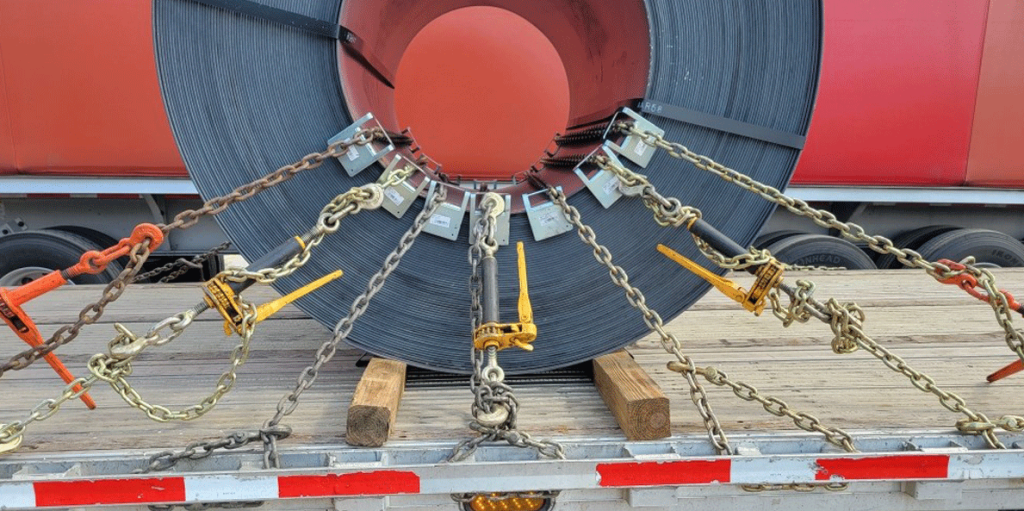
- Blocking refers to placing lumber or other sturdy material directly against the base of the cargo to prevent it from sliding. For a heavy crate, this could mean nailing 2x4s to the wooden floor of a trailer around its perimeter.
- Bracing refers to using larger structures to prevent tipping, often by transferring forces to the trailer’s frame.
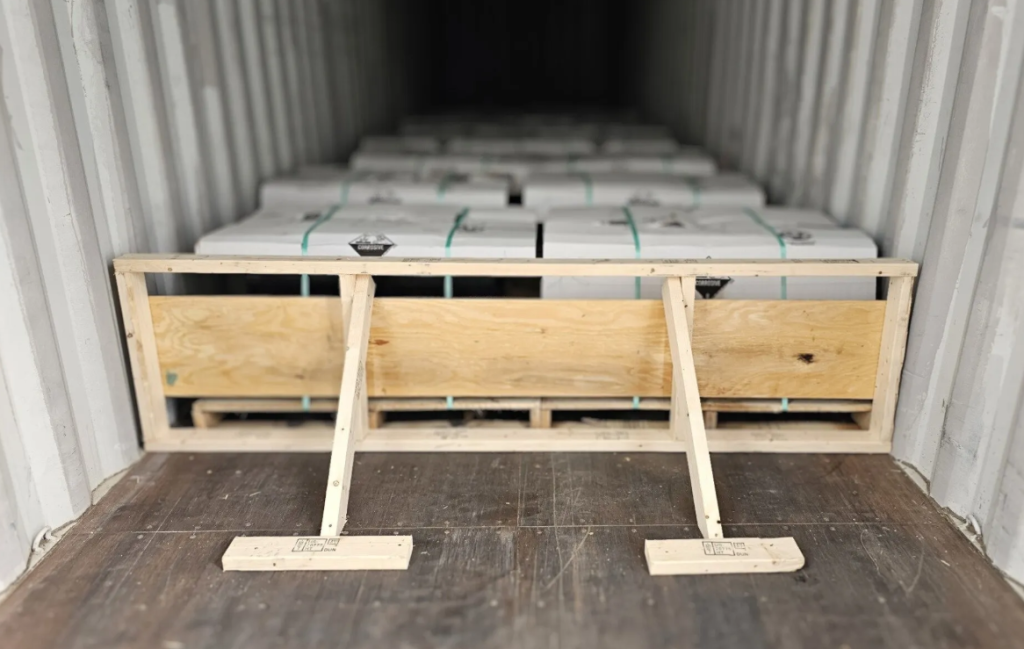
For items that are prone to sliding, like a smooth metal tank, blocking can be more effective than relying solely on the friction generated by tiedowns. The regulations recognize the value of these methods, and in some cases, proper blocking and bracing can reduce the number of tiedowns required.

For example, if a piece of cargo is held firmly against the headboard of the trailer, that structure prevents forward movement, fulfilling the 0.8 g forward force requirement.
Specialized Equipment: From Coils to Concrete Pipes
Many common loads have such unique properties that general-purpose equipment is insufficient. This has led to the development of specialized securement systems.
- Coil Racks: Used for securing metal coils, these are cradles that prevent the coil from rolling.
- Pipe Stakes: These are vertical posts that can be inserted into the stake pockets of a flatbed trailer to contain cylindrical cargo like pipes.
- Chocks: Shaped blocks used to immobilize the wheels of vehicles or other rolling equipment being transported.

Using the correct specialized equipment is not just a best practice; it is often mandated by the commodity-specific rules we will discuss in the next step. Attempting to secure a 40,000-pound steel coil with only straps and no coil rack would be a flagrant violation and extraordinarily dangerous.
The Modern Solution: High-Quality Cargo Nets
A versatile and increasingly popular solution for a wide range of cargo types is the use of high-strength netting.

High-Tensile Cargo Lifting Net Straps for Heavy-Duty Hoisting Safety
This lifting net combines application-oriented design, robust construction, reliable performance, and user-centered adaptability to deliver a durable and efficient solution for demanding industrial hoisting operations.
Unlike individual straps that apply pressure along narrow lines, a well-constructed net envelops the cargo, providing both containment and restraint over a wide surface area. This is particularly effective for:
- Irregular Loads: Securing piles of loose items, suchs as landscaping debris, stacked tires, or even military equipment(Military Pallet Cargo Net), can be difficult with straps. A net conforms to the shape of the load.

- Palletized Cargo: While pallets are often secured with straps, a heavy-duty truck netting system can provide an additional layer of security, containing any smaller items that might shift off the pallet.
- Light- to Medium-Duty Trucks: For vehicles under the 10,001-pound threshold but still carrying commercial loads, a cargo net is often the most efficient and effective way to comply with state and local securement laws.
When selecting a cargo net, it is vital to ensure it has a proper rating and is made from durable, weather-resistant materials. The same principles of WLL apply;

the net system as a whole must have an adequate rating for the cargo it is securing.
Table 2: Comparing Securement Methods for Different Cargo Types
| Cargo Type | Primary Challenge | Recommended Method | Secondary Method / Consideration | Common Mistake |
|---|---|---|---|---|
| Palletized Boxes | Tipping, shifting, individual item loss. | Web straps over the top, combined with shrink wrap. | Blocking at the base, use of a cargo net for containment. | Not using edge protectors, causing straps to fail. |
| Heavy Machinery | High center of gravity, concentrated weight. | Grade 70 chains as direct tiedowns to approved points. | Blocking at wheels or tracks to prevent sliding. | Attaching chains to non-structural parts of the machine. |
| Steel Beams | Abrasive surfaces, tendency to slide. | Grade 70 chains, often in a crossed pattern. | Blocking between layers (dunnage) and at the front/rear. | Using web straps without extensive edge protection. |
| Loose Debris | Containment of small, light items. | A tightly secured, full-coverage tarp. | A cargo net system over the top of the tarp. | Using a tarp with rips or tears, allowing material to escape. |
| Large Boulders | Irregular shape, no clear attachment points. | Chains in a cradle configuration, plus blocking. | Aggregate WLL must be sufficient for the rock’s weight. | Relying on the rock’s weight alone to keep it in place. |
Step 4: Mastering Commodity-Specific Securement Rules
While the general rules and WLL calculations form the foundation of compliance, the FMCSA has recognized that certain types of cargo present unique hazards that require more detailed, prescriptive regulations. These are found in §§393.116 through 393.136 of the regulations. For carriers who haul these specific items, knowing the general rules is not enough. You must master the specific requirements for your freight.

These rules are not suggestions; they are mandatory, and they exist because history has shown, often tragically, that the general rules alone are insufficient for these challenging loads.
Heavy Vehicles, Equipment, and Machinery
This is one of the most common categories of specialized freight, covered under §393.128. When you transport a bulldozer, an excavator, or even a large farm tractor, several key rules apply.

- Immobilization: The equipment must be chocked or blocked to prevent rolling. Any articulated sections (like the boom of an excavator) must be lowered and secured.
- Tiedown Requirements: Each piece of equipment weighing 10,000 pounds or more must be secured by a minimum of four direct tiedowns, each with a WLL of at least 5,000 pounds. The tiedowns should be affixed to designated anchor points on the equipment and the trailer, creating opposing forces to prevent forward, rearward, and lateral movement.
- Accessory Equipment: Any attachments like buckets or blades must also be independently secured to prevent them from moving.

A common error is attaching chains to hydraulic cylinders or other non-structural components of the machine. This can damage the equipment and does not provide a secure anchor point. Always look for the manufacturer’s designated tie-down points.
Securing Logs and Dressed Lumber
Logs (§393.116) and dressed lumber (§393.118) present different challenges. Logs are round and can shift easily, while bundled lumber is heavy and can have sharp edges.
- Logs: When transported, logs must be contained either by the vehicle’s bunks and stakes or by a cradle of chains. The number of tiedowns required depends on the length and arrangement of the logs. For a single stack of logs, two tiedowns are required. Additional tiedowns are needed for longer or multiple stacks. The tiedowns must be cranked as tightly as possible.

- Dressed Lumber and Similar Building Products: Bundles of lumber must be secured with a minimum of two tiedowns for bundles weighing up to 22,100 pounds. Heavier bundles require more tiedowns. For loads of multiple bundles, the tiedowns must be arranged to secure the entire stack. Edge protection is critical here if using straps.

The danger with these loads is shifting. A single log breaking free from a bundle can become a catastrophic projectile. The rules are designed to ensure the entire load acts as a single, solid unit.
The Challenge of Metal Coils
Perhaps no commodity is more notorious for difficult securement than metal coils (§393.120). A single steel coil can weigh over 40,000 pounds, concentrating an immense amount of mass in a small footprint. Their round shape makes them inherently unstable.

- Positioning: Coils can be loaded with the eye vertical (like a tire), eye to the side (like a spool of thread), or eye crosswise. The specific securement procedure depends on this orientation.
- Blocking: For a coil loaded with the eye crosswise, it must be prevented from rolling by using a cradle (like a coil rack) or by a system of heavy-duty timber blocking.
- Tiedowns: The number and arrangement of tiedowns are highly specific. For a 40,000-pound coil, you would typically need a system of chains running through the eye and over the top, arranged to prevent forward, backward, and sideways movement. The rules provide diagrams illustrating the precise angles and positions for the chains.


Relying on the friction from rubber mats alone is a common and deadly mistake. Without proper blocking and the correct number and configuration of chains, a coil will roll or slide in a hard braking or turning maneuver.
Concrete Pipes and Boulders
Concrete pipes (§393.122) and large boulders (§393.130) also have dedicated rules due to their weight and shape.
- Concrete Pipes: Pipes are not allowed to be transported on their sides unless they are loaded in a cradle. When loaded lengthwise, they must be blocked and braced to prevent rolling and secured by tiedowns. The number of tiedowns depends on the weight and length of the pipe.

- Boulders: For a single, large boulder, the challenge is its irregular shape and lack of attachment points. The primary method is to create a cradle of chains around the boulder. The aggregate WLL of this system must be at least half the weight of the rock. Additionally, blocking must be used to prevent any possibility of rolling or shifting. Simply placing a heavy rock on a trailer and assuming its weight will hold it is a grave error.

Intermodal Containers and Other Large Objects
The regulations also cover other specific items like intermodal containers (§393.126), which must be secured to the chassis using the integral locking devices, and automobiles and light trucks (§393.130), which must be restrained by a minimum of two tiedowns. The recurring theme is clear: for every common type of challenging cargo, the FMCSA has developed a specific, tested, and mandatory procedure. A professional’s responsibility is to know the rules for the cargo they carry.

Step 5: Implementing a Pre-Trip Inspection and En Route Monitoring Routine
The final and perhaps most crucial step in this process transcends the initial loading phase. Cargo securement is not a “set it and forget it” activity. It is a dynamic process that requires continuous vigilance. A load that was perfectly secure when leaving the yard can become dangerously loose after miles of vibration, road bumps, and temperature changes. This final step is about creating an unbreakable habit of inspection and re-inspection, turning regulatory requirements into a personal and professional code of conduct.
The Pre-Trip Inspection Checklist
Before even starting the engine, a thorough inspection of the cargo and securement system is non-negotiable. This is a formal part of the driver’s pre-trip inspection outlined in §392.7. What should you look for?

- Cargo Position: Has the cargo shifted at all since it was loaded? Are blocking and bracing elements still snug?
- Tiedown Tension: Are all straps, chains, and binders tight? A strap that was tight in the cool morning might loosen as the sun warms it. Chains can settle as the cargo compresses slightly.
- Tiedown Condition: Check every strap for cuts, frays, or UV damage. Run a gloved hand along chains to feel for cracks or deformation in the links. Check hooks and binders for any signs of stress or bending.
- Anchor Points: Ensure that the tiedowns are still firmly attached to the vehicle and, if applicable, the cargo. Check the rails and stake pockets of the trailer for any signs of damage or stress.
- Coverings: If the load is tarped, check that the tarp is secure and has no rips or holes that could allow it to billow or tear, or allow cargo to escape.
This is your last chance to correct a problem in a safe, controlled environment. Finding a frayed strap in the yard takes a few minutes to replace. Finding it on the side of a busy interstate is a much more dangerous and stressful proposition.
The Critical First 50 Miles
The regulations specifically mandate an inspection within the first 50 miles of a trip (§392.9(b)(2)). Why this specific distance? The initial part of a journey is when the load and the securement system “settle.” The vibrations and forces of the first hour of driving will reveal any initial slack in the system. Straps will stretch slightly, chains will seat themselves into the cargo, and blocking may compress.

Pulling over in a safe location—a rest area or a large, empty lot—to re-check the tension of every tiedown and the position of the cargo is not just a rule; it is one of the most effective safety procedures a driver can perform. Many potential failures are prevented in this first re-check.
Periodic Re-Examination During Transit
The law requires a driver to re-examine their cargo and its securement whenever there is a change of duty status, after driving for 3 hours, or after driving for 150 miles, whichever comes first. This ensures that the load is checked periodically throughout a long journey.

Think of it as a patient’s vital signs being checked by a nurse. Each stop is an opportunity to confirm the health of your securement system. You are looking for the same things as in the pre-trip inspection: tension, damage, and shifting. This is also the time to pay attention to the weather. A sudden rainstorm can make straps slick and cause them to lose tension. High winds can put unusual stress on tarps and high-profile loads. A professional driver is constantly aware of how the environment is affecting their vehicle and its cargo.
Documenting Your Diligence
While not always explicitly required for the cargo securement checks themselves, documenting your inspections can be a powerful tool. Noting in your log or on a trip report that you performed your 50-mile check and your periodic re-checks demonstrates a pattern of diligence and professionalism. In the unfortunate event of an incident or a dispute with an inspector, having a record that you consistently followed the required procedures can be invaluable. It transforms your actions from an unverified claim into a documented fact.
Case Study: A Preventable Accident
Consider the case of a flatbed driver hauling a large, crated machine. The driver secured it with four chains, correctly calculating the aggregate WLL, and started the trip. He skipped the 50-mile check, feeling confident in his work. Unseen by him, the wooden crate began to slowly compress under the pressure of the chains. After 100 miles, the chains were no longer tight. When the driver had to brake suddenly for traffic, the machine, now loose, slid forward with enormous force. It smashed through the trailer’s headboard and impacted the rear of the tractor’s cab. The accident was not caused by a failure to use the right equipment initially, but by a failure to monitor that equipment. A simple stop to re-tension the binders after the first hour would have prevented the entire catastrophic event.

This story, and others like it, are a stark reminder that the job of securing cargo is never truly finished until the cargo is safely delivered.
Frequently Asked Questions (FAQ)
What happens if my tiedown strap’s WLL tag is missing or unreadable? According to FMCSA regulation §393.104(f), if a tiedown’s WLL marking is not legible, it cannot be used as a cargo tiedown. An inspector will treat it as having a WLL of zero for the purpose of calculating aggregate WLL, which will likely result in a violation. The strap must be removed from service.
How many tiedowns do I need for a load that is not a specific commodity? For articles over 10 feet long, you need two tiedowns for the first 10 feet, plus one additional tiedown for every additional 10 feet or fraction thereof. For articles 5 feet or shorter and under 1,100 pounds, only one tiedown is needed. For anything in between, two tiedowns are required. However, you must always also meet the aggregate WLL requirement of 50% of the cargo’s weight. You must satisfy both the number rule and the WLL rule.
What are the fines for improper cargo securement? Fines can vary significantly by state and the severity of the violation, ranging from a few hundred dollars for a minor issue to thousands of dollars for major infractions. Violations also add points to a carrier’s CSA (Compliance, Safety, Accountability) score, which can lead to increased insurance premiums and more frequent inspections. In the event of an accident caused by load shifting, the civil and criminal penalties can be severe.
Can I use a combination of chains and straps on the same piece of cargo? Yes, you can mix tiedown types. When calculating your aggregate WLL, you simply sum the WLL of each device used. For example, you could use two chains (WLL 6,600 lbs each) and two straps (WLL 5,400 lbs each). Your total aggregate WLL would be (2 * 6,600) + (2 * 5,400) = 13,200 + 10,800 = 24,000 lbs.
Do the US DOT and FMCSA cargo securement regulations apply in Canada? Canada has its own set of federal and provincial regulations, primarily the National Safety Code (NSC) Standard 10. While there is significant overlap and the core principles are the same, there are differences in the details. The two countries have worked to harmonize their rules, but a carrier operating in both must be familiar with NSC Standard 10 as well as the FMCSRs.
What is the difference between a direct and an indirect tiedown? A direct tiedown connects the vehicle directly to the cargo (e.g., from a D-ring on the trailer to a lifting eye on the cargo). It is credited with its full WLL. An indirect tiedown passes over or around the cargo and connects two anchor points on the vehicle. It is generally credited with only half of its WLL toward the aggregate WLL calculation.
Is it okay to run a strap over a sharp metal edge if it’s a heavy-duty strap? No. Regulation §393.104(f)(5) explicitly requires that edge protection be used whenever a tiedown would be subject to abrasion or cutting. The material and thickness of the strap do not eliminate this requirement. The edge protector must be strong enough to resist being cut by the cargo.
Why do I have to inspect my load again after only 50 miles? The initial 50 miles are when the cargo and restraints “settle.” Vibrations and small movements cause tiedowns to lose some of their initial tension. This first re-check is a critical step to re-tighten everything and prevent a small amount of slack from becoming a major problem later in the journey.
Navigating the US DOT and FMCSA cargo securement regulations can appear to be a complex, even daunting, task. It is a world of numbers, codes, and specific procedures. Yet, to view it merely as a set of rules to be followed is to miss the profound human element at its core. Every chain that is tensioned, every strap that is inspected, and every piece of blocking that is nailed into place is an act of responsibility. It is a tangible commitment to the safety of the anonymous driver in the family car two lanes over, the road construction worker in a work zone ahead, and the driver’s own well-being.

The regulations are the codification of best practices learned over decades, often through the painful lessons of failure. To master them is to become more than just a truck driver; it is to become a true professional, a steward of the highway who understands that the most important cargo they carry is the public’s trust.

Leia os nossos artigos mais populares.
👉 Descarregar as nossas categorias de produtos gratuitas
👉 The Ultimate Guide to Installing Anti-Insect Nets in Greenhouses
👉 The Ultimate Guide to Choosing the Right Cargo Netting for Your Fleet
👉 HDPE vs Nylon Sports Netting: The Ultimate Guide
👉 A 5-Step Expert Guide: “Made to Order”: A Look at Our Custom Netting Process
👉 Como iniciar um negócio de redes de marca própria: Uma estrutura de 5 etapas para o trabalho
👉 O fabrico chinês vs. fornecedores locais: Guia do comprador de redes
